CONTRIBUTE TO THE JOURNAL
Contribute a verifiable cabinet story
Prepare an original cabinet contribution with source evidence, image permissions and commercial disclosures, then review and send the existing $10 enquiry email draft.
Go to the $10 enquiry email form
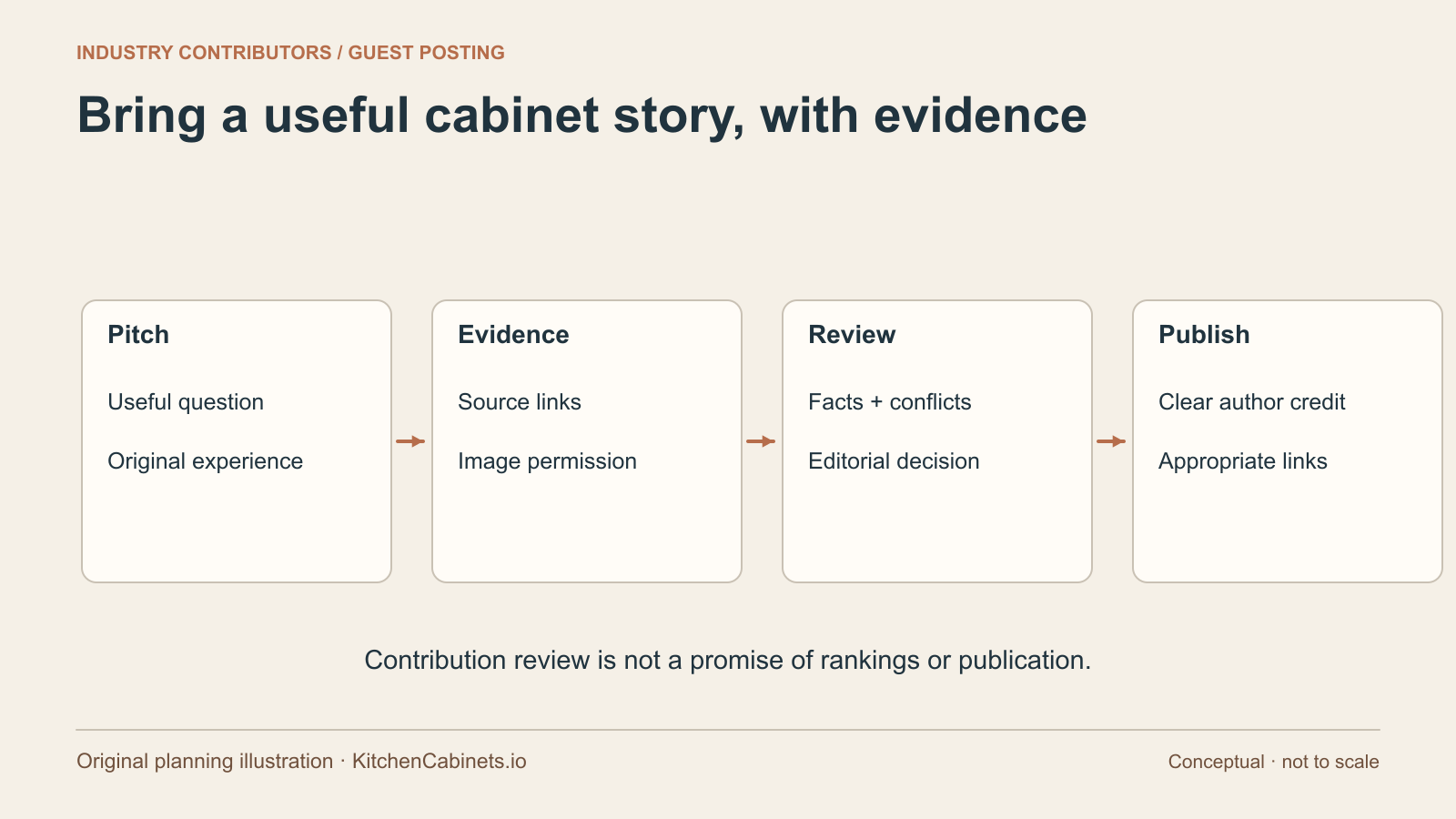
Propose a cabinet story that a reader can check
KitchenCabinets.io considers original contributions that help homeowners and specification professionals make a clearer cabinet decision. Use this page to prepare a submission packet for the editorial desk. A strong packet explains the reader's question, supplies evidence for the important claims and identifies who can authorize the words and images. It is not enough to attach an attractive finished kitchen and a business link. Tell us what a reader can learn from the decisions behind that kitchen.
The existing offer is a $10 guest-post enquiry. The form opens an email draft addressed to colin@industryarmymarketing.com; it does not submit an article to a publishing system, send an email or collect payment. Discuss editorial acceptance and payment arrangements with the desk before paying. An enquiry, payment reference or completed form does not guarantee a response, acceptance, publication, a publication date, continued availability, search indexing, rankings, traffic or customer leads. This is a proposal for editorial consideration, with the final scope and terms to be agreed directly.
Start with the decision and the people it serves
Describe the proposed story in two or three sentences. Identify the reader, the decision they face and the evidence you can contribute. For example, a designer might explain how a kitchen measurement packet prevented a refrigerator-door collision. A cabinet business might compare two specified drawer arrangements using measured internal space. A homeowner might document how a retained cabinet layout was assessed before refacing. Each proposal needs a useful question, not simply a broad topic such as beautiful kitchens.
Keep the subject connected to cabinets, storage, kitchen renovation or a closely related planning decision. Explain where your knowledge comes from: a project you worked on, a product you manufacture, a documented inspection or an original comparison. State your actual role without implying that KitchenCabinets.io certifies you or endorses your business. If the story depends on an interview, identify the speaker's role and whether they have agreed to be quoted. Do not invent an expert to make ordinary planning advice sound more authoritative.
Give the desk a concise cover note
Begin the email with a proposed title, your name, your organization if relevant and a short description of your involvement. Include a reply address used for the enquiry and a public business URL if one is relevant. Explain whether you are submitting for yourself or on behalf of a client. If you represent a business, say who can approve factual clarifications and permissions. The desk needs a responsible contact, not a directory of everyone involved in the project.
Then identify the materials included: manuscript, source register, image list, permission record and any proposed contributor link. Name missing items and say whether they can be supplied. A clear gap is easier to assess than a statement that all evidence is available on request. Keep the first email readable. You can describe a large set of supporting documents before sharing them, rather than sending a folder full of unrelated quotations, personal correspondence and full-resolution files without an explanation.
Prepare a manuscript with useful substance
Original long-form contributions should contain at least 2,000 meaningful body words. Headings, repeated biographies, source lists and promotional paragraphs do not create useful substance. Build the article around the decision, the options considered, the evidence used and the limitations. A practical sequence is to explain the starting condition, show the competing choices, walk through the checks and describe what the reader should verify on their own project. Length is a minimum quality condition, not a reason to repeat the same advice.
Use plain language and separate observation from interpretation. “The drawer opening measured this much in this cabinet” is an observation with a context. “This construction is always better” is a much broader claim and needs different support. Hypothetical examples are welcome when clearly labelled. Do not present a composite or invented example as a completed customer project. If you used writing assistance, verify every factual statement and disclose material assistance where it affects authorship or the origin of the work. You remain responsible for the submitted account.
Attach a claim-to-source register
For each important technical or comparative claim, identify the supporting document and where the relevant information appears. Record the publisher, title, direct URL, document date or revision, exact product or model and the page or section when available. Explain briefly what the source supports. A list of homepages is not a source register. The reviewer should be able to follow a claim about a runner, panel or appliance to the specific manufacturer or authoritative document that supports it.
Prefer current primary material for product facts: manufacturer specifications, installation documents, published test standards and official guidance within its stated scope. A supplier blog may help discover an issue, but trace its factual claim to the original document where possible. If a source is inaccessible, withdrawn or superseded, say so. Do not silently replace missing evidence with a confident sentence. Supply a source excerpt only when necessary and appropriately limited; a citation is not permission to reproduce a manufacturer's article, table or illustration.
Scope technical statements precisely
Name the country, product range, model and date when they affect the advice. A hardware load rating belongs to a particular system and installation, not every drawer carrying the same brand. Moisture-resistant material should not be renamed waterproof. A planning dimension is different from an installation requirement, and a requirement in one jurisdiction is not automatically a rule for every reader. State these boundaries near the claim rather than burying them in a general disclaimer at the end.
For stories involving electrical, gas, structural, plumbing or accessibility details, keep the contribution within its evidenced competence. Explain the planning question and the professional coordination required. Do not supply improvised installation procedures or assert compliance from a photograph. If the article says a project met a particular requirement, identify the basis and who made that assessment. The desk may ask for clarification, narrow a statement or decline material whose important technical claims cannot be independently understood and checked.
Show the reasoning in a worked example
A useful example lets the reader see why an option was chosen. Suppose the story concerns choosing a drawer for cookware. Describe the items, the relevant dimensions, the proposed drawer and the documents used to check compatibility. Explain a rejected option and the practical tradeoff. If weight or measurements are illustrative, label them hypothetical. The lesson should survive even if the reader chooses a different brand because the example teaches what to ask and what evidence to collect.
For a completed project, distinguish the original plan from later changes. Identify what was measured, what was supplied and which result was actually observed. A photograph can show an open door but cannot establish every hidden fixing or clearance. Explain any unavailable information rather than allowing the image to imply a full technical inspection. Before-and-after stories should also identify comparable viewpoints and any relevant change in lighting or staging, so the visual comparison does not do more argumentative work than the evidence supports.
Create an image and permission register
For every proposed image, provide a filename, a short description, the creator, the rights holder, the requested credit and the basis on which publication is permitted. Identify whether the image is an original photograph, an illustration, a supplied manufacturer asset or another licensed work. If permission is written, retain the actual permission and identify its scope. Credit alone does not establish a right to publish. A picture found on a supplier's website or social feed is not automatically available for reuse here.
Explain whether the permission covers website publication and any proposed crops or adaptations. Identify restrictions before submission. Do not promise rights on behalf of a photographer, homeowner, designer or employer unless you are authorized to do so. If an original illustration is supplied, label it as an illustration and identify any conceptual or not-to-scale elements. The desk needs an honest account of provenance; it does not need a manufactured claim that an image is a photograph of a real finished installation.
Supply images that can support the article
The editorial feature format calls for a native 1600 by 900 image or an appropriately cleared original illustration prepared for that use. Enlarging a small web image does not restore missing detail. Keep the original file and explain any edits that alter the scene or meaning. The form allows an image count of up to three, but a count is not an upload. Attach the files to the email draft yourself or agree an appropriate sharing method with the desk.
Write captions that explain what each image actually shows and why it matters to the decision. Include useful alternative-text information, such as a drawer arrangement or marked planning relationship, without treating it as another advertising field. Remove private documents, visible access codes, unnecessary faces and identifying details that do not serve the article. If a private home is involved, confirm the relevant permissions and discuss an appropriately general location description rather than assuming an exact address should be public.
Disclose commercial relationships and proposed links
State whether you work for, sell, represent or receive a benefit from a business mentioned in the contribution. Identify supplied products, paid writing, affiliate arrangements and client relationships that matter to a reader's assessment. Place the proposed disclosure in the packet so it can be reviewed with the article. A neutral tone does not remove a material relationship, and a short biography is not always enough to explain who supported the work.
The existing form asks for a destination URL and anchor text. Treat these as a proposed attribution for editorial review. Explain who controls the destination and why it helps the reader. Use a truthful organization or resource description rather than insisting on a ranking-oriented phrase. Commercial placements need appropriate disclosure and link qualification. Google's outbound-link documentation identifies sponsored qualification for paid placements; its spam policies describe manipulative link practices. No dofollow treatment, ranking credit or search benefit is promised by an enquiry or payment.
Protect private information before sending
The submission route needs contact information so the desk can consider the enquiry. It does not need customer phone lists, account credentials, government identifiers, payment-card details, access codes or private medical information. Remove those from manuscripts, screenshots, file names and supporting documents. Share project evidence in a form that supports the claim without exposing unrelated people. A redacted drawing may be more appropriate than a complete customer file, provided the redaction does not hide information essential to the argument.
Check photographs and document metadata as well as visible text. Kitchen photographs can reveal mail, family calendars or security equipment. A quotation can identify a homeowner even if its title has been changed. If permission or privacy is unresolved, flag the item and leave it out of the proposed public package until the issue is addressed. The desk cannot infer consent from the fact that someone appears in an image or once received a copy of a project drawing.
Review and send the email draft yourself
Complete the form with the proposed article information. Opening the submission email should prepare a message in your configured email application. Review the recipient, subject and body, attach the manuscript and supporting files, and then decide whether to send it. The website does not automatically send that message, charge the $10 or confirm delivery. Opening a draft is a preparation step; it is not evidence that the editorial desk has received or reviewed a submission.
If your device has no configured email application or nothing opens, compose an email directly to colin@industryarmymarketing.com with the same packet and a clear KitchenCabinets.io contribution subject. Check sharing permissions on any document links so the intended recipient can read them without obtaining unrelated account access. Retain your own copy. Do not send a password to make a document accessible, and do not pay merely to troubleshoot an email-draft problem. Any payment arrangement should be confirmed with the desk separately.
Understand review, changes and corrections
Editorial consideration can involve checking relevance, originality, source support, permissions, disclosures and the usefulness of the proposed article. The desk may ask questions, request revisions, remove a proposed link or decline the submission. A complete packet makes those questions easier to answer but does not guarantee that a review or response will occur. Do not treat silence as acceptance, a scheduled publication or an agreement to any commercial term. No response deadline is established by this page.
If a piece is accepted, confirm the agreed version, byline, credits, disclosures and any payment terms before publication. Raise a factual concern with the specific sentence and supporting evidence rather than asking for an unrelated promotional rewrite. After publication, corrections can be sent to the same desk address with the article URL, the issue, the evidence and the proposed factual correction. Distinguish a factual error from a later product change. Keeping that distinction clear helps maintain an accurate article without pretending that every historical statement describes today's product.
Source references
Original practical guidance from the KitchenCabinets.io editorial desk. Google documentation supports the specifically attributed search and link-policy points; no affiliation or search outcome is implied.
Submit Your Guest Post
Fill out the form below and we'll open your email client with all the details pre-filled. Attach your article and images to the email.