For Cabinet Businesses · Cabinet manufacturers, dealers, designers and installers
A useful cabinet guest post starts with a real problem, not a backlink
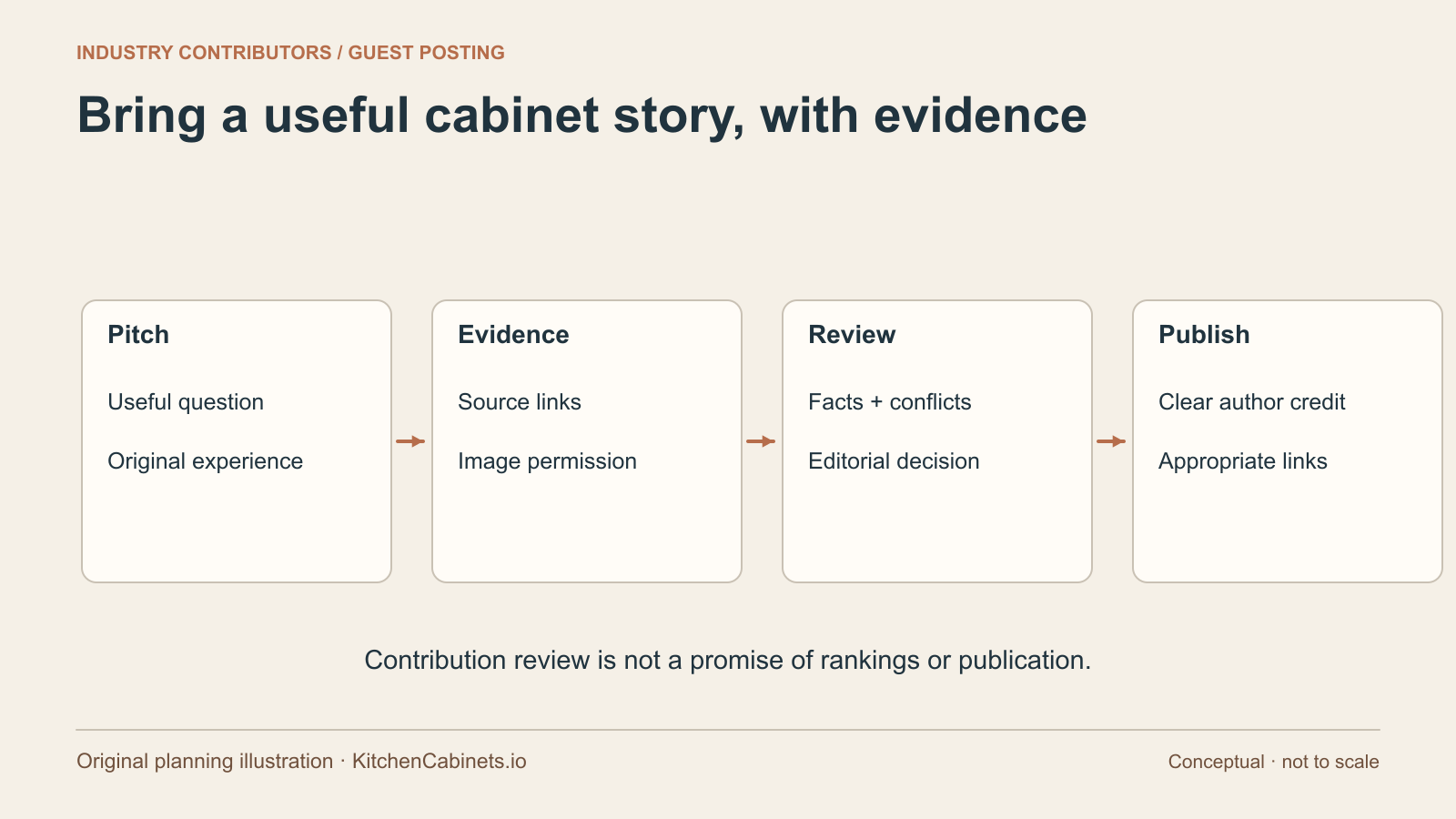
Develop an evidence-led cabinet guest contribution with original examples, image permissions and transparent commercial links.
Start here
Cabinet manufacturers, dealers, designers and installers have access to information homeowners rarely see: why an order changed, which dimension caused a fit problem, how a finish was selected, or what made a handover clearer. That practical knowledge can become a useful editorial contribution. It is much less useful when it is reduced to a generic article that repeats a company slogan and inserts a sales link every few paragraphs.
This guide is for cabinet businesses considering a contribution to KitchenCabinets.io. It explains how to develop a credible submission and assemble an evidence package. It does not promise acceptance, publication, search indexing, leads or rankings. Use the current requirements on /guest-post when preparing a submission. If the objective is business information or a city presence rather than an editorial article, review /claim-your-city separately. A contribution and a business placement serve different reader needs.
Choose a question your actual experience can answer
Begin with a recurring customer question or a difficult project decision. A dealer might explain how to compare two quotes with different panel allowances. An installer might show how a clear punch list prevents confusion at handover. A manufacturer might explain the difference between a product-family name and an exact drawer specification. The topic should be narrow enough that the writer can provide concrete details unavailable in a generic overview.
Test the proposed angle by completing this sentence: after reading, the audience will be able to make this specific decision or avoid this specific misunderstanding. If the answer is simply know our brand, the article needs another approach. Brand identification can be transparent in the author biography and relevant disclosures. The body should earn attention through information that helps the reader even if they never contact the contributor.
Choose an audience before drafting. A homeowner comparing quotations needs different language and detail from a cabinet shop evaluating a manufacturing workflow. Do not attempt to serve every audience in one piece. State what the reader already knows, what evidence the article will add and which decisions remain outside its scope. This gives an editor a clear basis for judging the contribution and keeps the finished article from drifting into a brochure.
Bring evidence that belongs to the particular story
Useful evidence can include an approved drawing excerpt, a measurement worksheet, a documented sequence of revisions, original project photographs or a comparison table based on identified product documents. It should support the article's main explanation. A large collection of attractive photographs does not prove a claim about durability, installation speed or customer outcomes. Match each important statement to the evidence that actually supports it.
Separate direct observations from manufacturer information and interpretation. For example, a contributor can describe what was measured on a particular project, attribute a hardware specification to the manufacturer and explain why the team selected that arrangement. Those are three different kinds of statements. Blending them into a broad claim that the system is always better makes the article less trustworthy and harder to review.
If evidence is unavailable, narrow the claim. A writer may have a useful process explanation without enough records to quantify savings or performance. Describe the process and its limitations instead of inventing a percentage. Exactness is not limited to numbers: a clear before-and-after drawing revision can demonstrate a decision without asserting an unsupported increase in efficiency. Readers benefit from understanding the reasoning and the circumstances in which it applies.
Follow a project decision from constraint to result
A strong case study explains the starting condition, the options considered, the decision and what was observed afterward. The starting condition might be a sink cabinet with service access that limits storage. The options could include leaving open access, using a specific organizer or relocating an adjacent storage function. Explain why the selected option fit that project and what trade-off the client accepted.
Avoid writing the result backward as though the choice had been obvious all along. Readers learn from the rejected alternatives and the constraints that mattered. If a change solved one problem while reducing another kind of storage, say so. If the installation has only recently been completed, report that time boundary rather than presenting it as a long-term durability record. A truthful limitation often makes a practical article more useful.
Keep client information appropriately limited. A useful story rarely requires a private address, an identifiable household routine or commercial terms. Obtain the necessary permissions for the material being submitted and remove details that do not contribute to the explanation. Describe a hypothetical example as hypothetical if real project information cannot be shared. Combining multiple jobs into an unlabeled single success story misleads the reader about what actually occurred.
Make the article original in a meaningful way
Google's people-first content guidance asks publishers to consider originality, usefulness and value for readers. For a cabinet business, originality need not mean inventing a new cabinet category. It can mean explaining a real decision with documents, photographs and observations that the contributor is qualified to discuss. Rewriting an existing product page with different adjectives does not add that kind of value.
Before submitting, compare the draft with the manufacturer's source material and the business's own website. Attribute factual product information and avoid reproducing long passages. Add the contribution's own analysis: which specification was ambiguous, how the team clarified it, and what a reader should ask on a similar project. The manufacturer document supplies product facts; the contributor supplies a transparent account of the practical decision.
Do not submit the same generic piece to multiple sites with only city names and links changed. Each publication should have a clear audience reason to carry the article. If the business has already published related material, disclose it and explain what is new in this submission. An editor can then assess the article honestly rather than discovering later that the contribution is a lightly altered copy of a sales page.
Treat links as references and disclosures
A link should help the reader verify information, understand a product or identify the contributor. It should not be the hidden reason an otherwise empty article exists. Google's spam policies identify manipulative link practices, including certain paid links and optimized links in guest posts, as potential link spam. A publication fee or editorial relationship does not establish a right to pass ranking credit or obtain a particular search result.
When a commercial relationship exists, disclose it and let the publisher apply appropriate link treatment. Google's guidance describes qualifying commercial links using attributes such as sponsored or nofollow. The editorial process should decide where a link helps the reader and how the relationship is represented. Do not demand repeated keyword-rich anchor text as a condition of contributing useful information.
Use descriptive, natural references. A manufacturer installation guide can be linked by its actual title. An author biography can identify the contributing business accurately. If a product was supplied, a service paid for or a relationship relevant to the recommendation exists, explain it. Transparent context lets readers evaluate the advice without having to infer whether the author is an independent observer, a dealer or the product manufacturer.
Assemble a usable image and document package
Provide original files that are large enough for the publication's intended image treatment and identify who created them. Include a short description of what each image shows, the project stage and any permission or credit requirements. A screenshot from a supplier website is not automatically authorized for republication. Neither is an image found through a search engine or copied from another company's completed kitchen gallery.
For before-and-after photographs, keep the comparison fair. Explain differences in camera position, lighting, project stage or furnishings when they affect interpretation. Avoid implying that a cabinet change produced an outcome that also depended on unrelated work. A detail photograph can sometimes tell a clearer story than a dramatic room comparison: a revised service opening, a drawer layout or an accurately labeled sample shows the decision directly.
Drawings need the same care. Remove private details, identify whether the drawing is conceptual or represents the installed project, and obtain permission to share material created by another professional. A simplified original diagram may be preferable when a construction drawing contains unnecessary information. Label the diagram's purpose and limitations so readers do not mistake an explanatory illustration for installation instructions or a design approved for their own building.
Use a structure an editor can assess quickly
A practical submission can begin with a short summary of the reader problem and the contributor's relevant experience. Follow with the evidence available, the proposed article structure and any commercial relationships. This lets the editor assess the angle before reviewing a long draft. Do not fill the pitch with claims of guaranteed traffic or authority; explain what the reader will learn and why this contributor can explain it.
In the article itself, use headings that advance the decision. Constraint, options, selection, result and transferable questions can form a useful sequence, though every story need not follow identical labels. Include definitions where technical terms matter. If a table is used, make the comparison basis clear and avoid a fabricated score that gives the contributor's preferred option a predetermined victory.
End with practical next questions rather than a repeated sales pitch. The reader might need to request a product code, compare an inclusion schedule or plan an inspection. A concise author identification can sit separately from that advice. Keeping the editorial explanation coherent makes the contribution more useful to the publisher and creates a better representation of the business's expertise than aggressive promotional language.
Work through a credible submission example
Imagine a cabinet dealer proposing an article called The drawer measurement that changed our storage plan. The project involved a household wanting to reuse a large organizer. The first layout used nominal cabinet dimensions; checking the finished internal drawer dimensions revealed the organizer would not fit. The dealer revised the arrangement and documented the accepted clear dimensions. That is a narrow, understandable story with a practical lesson.
The evidence package contains a redacted initial plan, a revised dimension sketch, permission-cleared photographs and the relevant hardware document. The draft explains what was known initially, why the nominal measurement was insufficient and how the revised schedule was confirmed. It does not claim that every competing drawer system wastes space or that the dealer saves every client a particular sum. The lesson is about specification, not a disguised brand ranking.
The author biography identifies the dealer and its role in the project. Any manufacturer relationship is disclosed. Product links support specific facts, while the publisher determines commercial link treatment. The article directs readers to questions they can use with their own supplier. This is stronger than a broad promotional piece because a reader can apply the reasoning and an editor can verify what the story actually demonstrates.
Keep business placement separate from editorial approval
A business may need its contact details, service area or capabilities presented clearly before it has a suitable case study. That is a business-information task. Review /claim-your-city for the relevant route and provide accurate details that can be checked. Do not use an editorial submission to imply an office, showroom or service relationship that does not exist. A city reference should describe the business truthfully.
The planned /marketing route addresses a different conversation about marketing support. Refer to the current route and available information rather than assuming a particular package, price or outcome. A marketing discussion does not change the evidence required for an editorial claim. Likewise, an accepted article should not be described as an independent certification of the contributor's products or services.
Review the current /guest-post requirements for submission terms, format and editorial handling. Existing page wording may change, and this guide does not establish a fee, turnaround promise or acceptance policy. Ask about any unresolved publication requirements through the appropriate submission process. Preparing an accurate, complete contribution makes review easier; it does not remove the editor's responsibility to assess relevance, evidence and reader value.
Check the final draft against the reader's decision
Before submitting, read every paragraph with one question in mind: does this help the intended reader understand the problem or choose a next step? Remove repeated claims of quality that add no evidence. Replace vague praise with the actual constraint, measurement or document. Check that examples are labeled, manufacturer facts are attributed and limitations remain visible. A shorter precise explanation is preferable to padding around a thin claim.
Confirm the author's identity and role, source links, image permissions and commercial disclosures. Verify that any numbers can be traced to records and that the conclusion does not go beyond them. If the article names a product configuration, check the exact model and market information again before submission. These checks support editorial credibility without pretending that a content review is a product certification or engineering assessment.
A useful cabinet contribution gives the reader access to professional reasoning that would otherwise remain inside a quotation meeting or project folder. The business earns a clear attribution by sharing that reasoning responsibly. Begin with a real question, show the evidence and make the limits understandable. Then use /guest-post for the current editorial route, keeping business listings and marketing discussions distinct from the article's value to readers.
Sources and editorial notes
This is original explanatory reporting and planning analysis. Manufacturer documents support the specific product facts attributed in the guide; they do not imply affiliation. Sources were checked for this launch. The illustration was created for this article; it is not a photograph of a completed project.
Corrections or a documented technical update? Email the editorial desk.