FOR CABINET BUSINESSES
Prepare a useful marketing enquiry for your cabinet business
Prepare a cabinet business marketing enquiry with clear goals, real evidence, approval responsibilities and an honest handoff.
Start here
A clear marketing enquiry begins with the business you actually operate, the customers you can serve and the evidence you can share. A cabinet manufacturer, independent dealer and installation business can have different priorities even when their websites use similar words. Before discussing a campaign or a new page, explain what a worthwhile enquiry looks like for your company and what information a prospective customer needs before making contact.
This page helps you prepare that brief for a marketing conversation through KitchenCabinets.io. It describes information worth gathering and decisions worth making; it does not establish a service package, price, delivery date or performance promise. The current contact flow prepares an email draft in your mail application. Opening that draft does not send it, save a website submission, reserve a territory or make a payment. Review and send the message yourself if you wish to proceed.
Choose the route that matches your purpose
Use /marketing when the purpose is to discuss a business marketing need: explaining an offering more clearly, organizing evidence, improving a customer journey or assessing a possible project. Describe the problem and the proposed scope of discussion. An enquiry starts a conversation; it does not authorize unspecified work, create an account or confirm that a particular implementation service is available. Any actual scope and terms need to be established separately.
Use /guest-post when the purpose is an editorial contribution that helps readers understand a cabinet decision. That route is about a proposed article, its author, supporting evidence and relevant disclosures. Sending a marketing enquiry does not approve an article, and submitting an article does not purchase marketing work. If the business has both needs, identify them separately so the editorial question can be assessed on reader value rather than being obscured inside a commercial request.
Use /claim-your-city for a city or territory enquiry under the current page's terms. Identify the actual business, location and service area, and ask about anything that remains unclear. The route name does not establish exclusivity, a physical office, a confirmed reservation or a search result. An email draft is not a completed claim. Keep the requested territory distinct from places where the business already operates and from locations where it merely hopes to expand.
Describe the real business in plain language
Begin the brief with the business name, website, contact person and that person's role. Explain whether you manufacture cabinetry, distribute named lines, operate a showroom, provide design work, install cabinetry or coordinate other parties. If several activities sit under different businesses, show the relationship accurately. A prospective marketing project should not have to reconstruct the organization from conflicting logos, old domains and a social profile that describes an earlier service.
State who can become a customer and where the work can be supplied. A manufacturer may work through dealers rather than take homeowner orders. A showroom may serve visiting customers while installation is arranged separately. An installer may accept projects within a practical travel area. These distinctions influence page wording, contact questions and the evidence needed. Avoid describing a desired future capability as an established present service merely because it would make an attractive headline.
List any important constraints, such as appointment arrangements, the need for drawings before a detailed quotation or product lines that require confirmation. Do not include private customer information to illustrate the point. A brief can explain that projects require technical review without sharing a household's plans. Accurate limits help a marketing discussion focus on suitable enquiries rather than increasing contact volume from people the business cannot serve.
Bring product and service evidence that can be checked
Create a short inventory of the claims the business wants to communicate. For each claim, identify the product or service concerned and the evidence available. A statement about a cabinet line should point to that line's current documentation. A statement about your own installation process should describe your actual responsibilities. Supplier affiliations, certifications, warranties and service commitments need specific support; a recognizable brand name in a photograph does not establish a formal relationship.
Separate evidence you own from evidence you can reference. You might own an original project photograph but need permission to republish a manufacturer's diagram. You might have access to a product specification without permission to reproduce an entire catalogue. Record the source, the relevant date and any usage restriction. This makes it easier to plan appropriate content without assuming that every file in the company's shared drive is cleared for public use.
Note uncertainty explicitly. A finish may be available only by confirmation, a brochure may describe another market or a service arrangement may have changed. Mark those items for review rather than asking a writer to turn them into confident promises. A useful brief can contain unanswered questions. Its job is to expose the decisions needed before public wording is approved, not to present a polished story that hides gaps in the underlying facts.
Explain the customer decision you want to improve
Describe one point at which suitable prospects currently become confused or stop progressing. Perhaps visitors cannot tell whether the business sells to homeowners, what information is needed for an initial quotation or whether installation is included. Explain what you have observed and how you know it. A recurring question in actual enquiries can support a useful hypothesis. It does not prove that every visitor leaves for the same reason.
Write the intended improvement as a customer outcome. For example, a visitor should be able to identify the correct product discussion and send enough context for an initial response. That is more actionable than a broad request to make the website premium. The visual presentation may matter, but it should support the decision the visitor is making. Include the specific page or contact step involved if you know it.
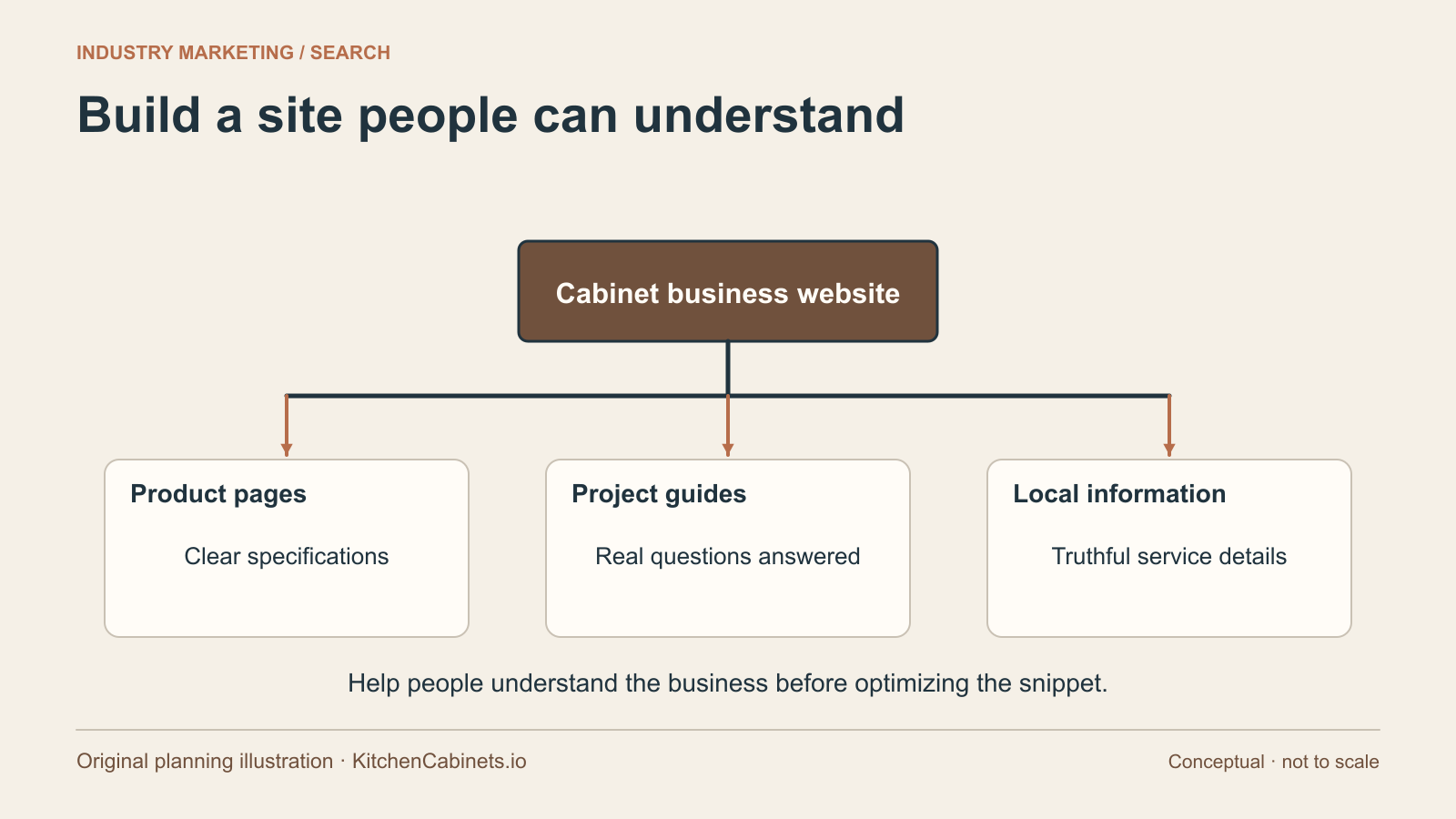
Google's people-first content guidance emphasizes useful, original information for readers. In a marketing brief, that principle supports collecting real product and project knowledge before asking for more copy. A new page should have a job that existing pages do not already perform well. If the evidence suggests that a confusing contact instruction is the problem, a focused correction may be more appropriate than commissioning a large collection of overlapping articles.
Set goals with a baseline and a time boundary
Record the current situation before proposing a target. Explain which enquiries are suitable, how they are currently identified and what information is reliably available. A simple baseline might distinguish requests for a supported service from enquiries outside the service area. If the business has no consistent records, say so. Establishing a usable baseline can be an early task; inventing a historical conversion rate cannot.
Define the event you want to observe. A visitor opening an email draft, sending an email, receiving a response and becoming a qualified prospect are different events. A reporting plan should not combine them under one label called leads. State who can confirm each stage and whether the evidence is available. If email delivery or customer attribution cannot be measured reliably, keep that limitation visible in any proposed evaluation.
Choose a review period and explain factors that could affect interpretation, such as a product launch, showroom change or seasonal workload. Google's Search Essentials states that meeting its requirements does not guarantee crawling, indexing or serving in search results. A marketing goal should therefore distinguish work that can be delivered from outcomes that depend on visitors, platforms and other conditions. No enquiry should be framed as a purchase of a guaranteed position or immediate search inclusion.
Define approval scope before access or execution
Name the person who can approve business facts and the person who can authorize spending or publication. They may be the same person, but the brief should make the responsibility clear. A product specialist might confirm specifications while an owner approves the commercial scope. Identify who provides the final wording decision when several people review the material. This avoids a project treating informal comments from one participant as permission for unrelated actions.
Describe the level of work being requested. You might want an initial discussion, a proposed scope, a draft for review or an implementation quotation. Those stages are not interchangeable. Ask for the proposed deliverables and boundaries in writing before authorizing execution. If public changes, domain settings, paid services or account connections become relevant, they should be identified specifically in that scope rather than presumed from a general request for marketing help.
State what needs review before public use: product facts, project permissions, brand presentation, commercial terms or contact details. Also identify material that must remain private. The goal is a workable decision process, with clear responsibilities and a concrete result to assess. Do not send passwords or broad account access in an opening email. Initial scoping can usually proceed from public pages and appropriately limited supporting information.
Prepare assets and permissions for a controlled handoff
Collect the approved logo files, brand spelling, usable photographs and relevant documents in a clearly organized folder. Give files understandable names and note which versions are current. Include an asset register that connects each image to its creator, permitted use and required credit. Owning the cabinetry in a photograph does not necessarily mean the business owns the photographer's rights or has permission to identify the homeowner.
For project material, establish what may be shown and what should be removed. Private addresses, personal documents visible in a room and identifying customer details may be unnecessary to explain the work. A useful case study can often focus on a permission-cleared detail or a simplified original diagram. Label conceptual illustrations appropriately rather than presenting them as photographs of completed projects. Keep original files separate from edited exports so approved versions can be traced.
Do not include a full customer database in an initial brief. Describe the kind of records available and the decision they might inform. If a later agreed scope needs data, establish the required fields, purpose, access method and handling responsibilities first. An aggregate summary may answer the question without transferring individual records. The opening enquiry should provide enough context for scoping while avoiding unnecessary disclosure of information about customers or staff.
Work through a practical enquiry example
Consider a hypothetical dealer with one showroom and several cabinet lines. Suitable prospects often ask whether a quotation includes installation, but the website does not explain the dealer's coordination role. The owner wants more useful initial conversations. A clear brief identifies the showroom, the actual installation arrangements, the current quotation page and examples of recurring questions with private details removed. It does not assert that a new campaign will produce a particular sales increase.
The proposed customer outcome is that visitors understand the dealer's role and know which project information to provide. The owner can approve commercial wording, while a product lead will check line-specific references. Existing photographs are listed with permission status, and an older brochure is flagged for replacement. The brief requests a discussion about clarifying the relevant pages and contact journey. It does not authorize publishing new claims or connecting paid advertising accounts.
The baseline separates initial contact, a suitable project discussion and a later quotation. Email records may support some stages, while website attribution is incomplete. That limitation becomes part of the proposed measurement plan. The enquiry also identifies a separate possible guest article about a real specification decision and directs that proposal to /guest-post. A city enquiry, if wanted, is handled through /claim-your-city rather than being treated as included in the marketing discussion.
Review a proposed scope against the original problem
When a response or proposal arrives, compare its deliverables with the customer decision in your brief. Ask which pages, assets or contact steps are included, what evidence the business must supply and what review is expected. A list of activities is easier to assess when it explains the intended result and how completion will be checked. If the proposal includes something outside the original request, clarify it before assuming it is necessary or authorized.
Distinguish completed work from continuing operation. A draft page, a published page, a tested contact path and ongoing reporting are different deliverables. If maintenance or recurring work is proposed, ask what triggers it, who is responsible and what happens when information is missing. Do not infer an implemented automation, a monitoring service or a response commitment from the existence of a marketing enquiry page.
Review commercial terms as actually supplied. This guide establishes no price, billing arrangement, minimum term or refund policy. Any purchase decision should use the applicable written proposal and current terms. Similarly, a discussion about city presence does not establish an exclusive territory unless a specific valid agreement says so. Keep the accepted version of the scope and the approved business facts together so later changes can be assessed against a common reference.
Send a concise opening message with useful next questions
Your first message can summarize the business, the problem, the intended customer outcome and the evidence available. Identify the main website pages involved, who can approve facts and the kind of conversation you are requesting. Mention unresolved rights or measurement issues plainly. You do not need to attach every document at once. An organized summary lets the recipient ask for the relevant next material without receiving an unfiltered collection of private files.
When the contact action opens your email application, check the recipient, subject and draft text. Add the context you want to share and send it yourself. Until you send, the draft remains an unsent message in that application. There is no website submission receipt, backend save, payment or territory reservation created by opening it. If your mail application does not open, use your normal email setup to complete the intended message rather than assuming the enquiry was received.
Keep a copy of the sent brief and any later agreed revisions. The useful result is a shared understanding of the real business, the customer decision, the available evidence and the next authorized step. Use /marketing for that discussion, /guest-post for a reader-focused editorial proposal and /claim-your-city for the separate city enquiry. Clear preparation makes each conversation more productive without promising capabilities or outcomes that have not been established.
Source references
Original practical guidance from the KitchenCabinets.io editorial desk. Google documentation supports the specifically attributed search and link-policy points; no affiliation or search outcome is implied.
Open a marketing enquiry
This opens an email draft for you to review and send. It makes no website submission, reservation or payment.
Open a marketing email