For Cabinet Businesses · Cabinet manufacturers, dealers and installers
Cabinet business SEO: build pages that answer a real buying decision
Build useful cabinet business pages, accurate local information and a measurable path from search discovery to enquiry.
Start here
A cabinet manufacturer's search problem differs from a dealer's, and a showroom's needs differ from an installer's. A manufacturer may need to explain product lines and distribution. A dealer may need to help customers compare specifications and arrange a visit. An installer may need to show the scope of work and service area. Treating all three as the same collection of city keywords produces pages that say little about what the business actually does.
A useful SEO plan starts with accurate business information and the questions that lead to a genuine enquiry. It then connects those questions to pages that can be crawled, understood and maintained. This guide describes that work for cabinet businesses. It does not promise rankings, immediate indexing, leads or inclusion in an AI answer. Google's Search Essentials explicitly notes that meeting its requirements does not guarantee that a page will be crawled, indexed or served in results.
Define the business and the customer it actually serves
Write a plain description of the business before opening a keyword tool. Identify whether it manufactures cabinets, sells named product lines, designs kitchens, installs supplied cabinetry or combines those roles. Describe the customers it can serve and the geographic limits of the service. A visitor should not have to infer from photographs whether the company is a manufacturer, a local dealer or a directory connecting them to another business.
Identify the decisions that precede a useful enquiry. A homeowner might need to know whether a showroom carries a particular type of cabinetry. A builder might need product documentation and ordering coordination. A designer might need finish samples and technical information. These journeys can share some pages, but each requires clear answers. Do not force every visitor through a generic request-a-quote page before explaining basic scope.
Check the accuracy of the same information across the website, business profiles and submitted listings. Names, contact methods, operating locations and service descriptions should describe the real organization. Where a location is not open to visiting customers, do not present it as a showroom. Accuracy reduces confusion for readers and provides a more defensible foundation for search work than adding more pages around an unclear business identity.
Map customer questions to distinct useful pages
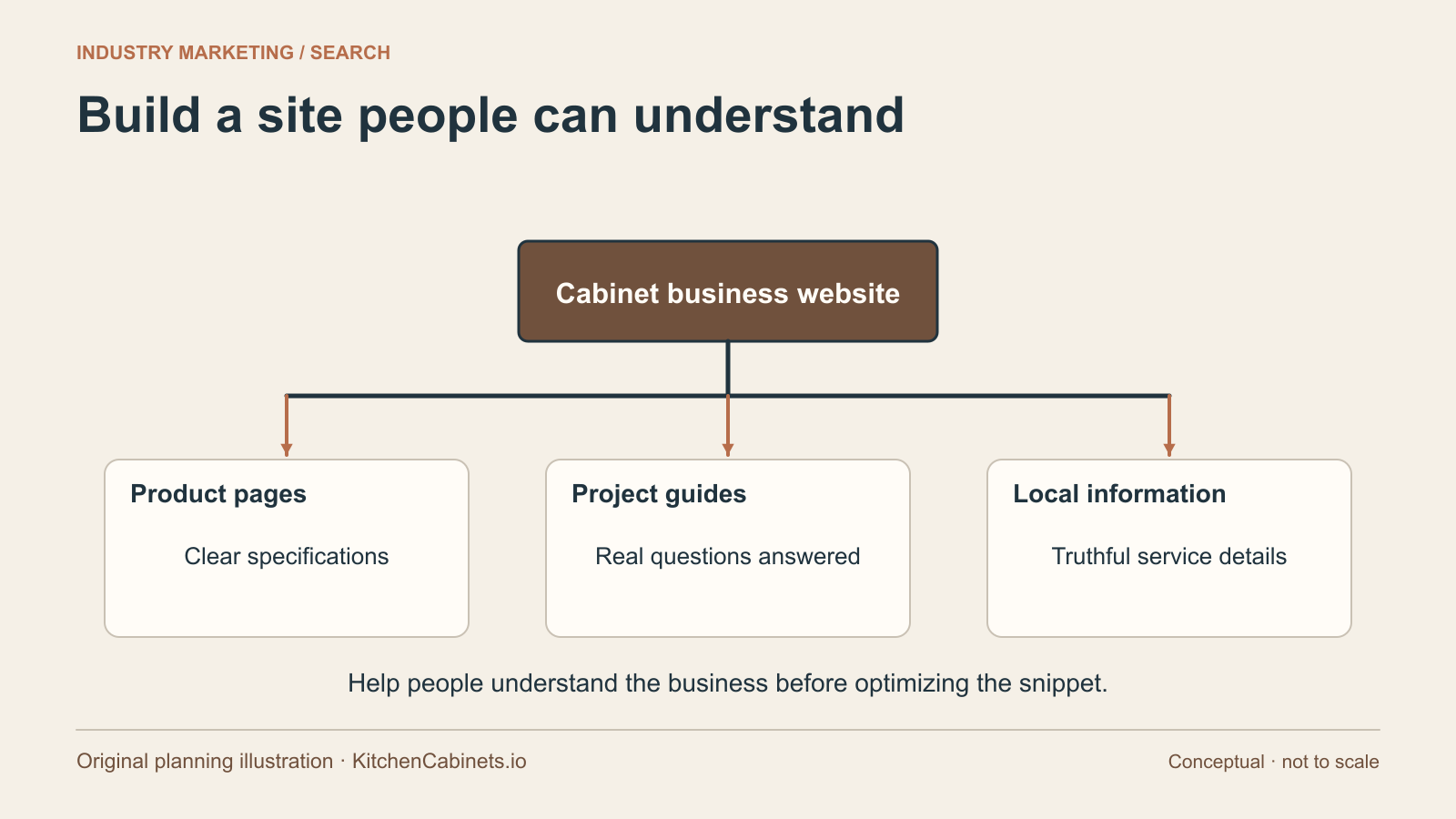
Create a small page map based on the buying process. Core pages might explain the cabinetry offered, how design or quotation works, where customers can see samples, what installation includes and how aftercare is handled. Supporting articles can address specific misunderstandings, such as nominal cabinet size versus usable drawer dimensions. Each page should have a reason to exist beyond targeting another variation of the same phrase.
Choose one primary job for each page. A product-line page can identify the relevant line, available documentation and the next appropriate contact. A quote-comparison article can explain inclusions and assumptions without pretending to quote a visitor's kitchen. A project story can demonstrate a particular decision with permission-cleared evidence. These pages can link together, helping the visitor move from research to a meaningful enquiry without repeating the same sales paragraph everywhere.
Audit existing pages before creating more. Several weak pages about identical services may be less useful than one clear explanation with relevant examples. Record which page owns each question and which related pages support it. This reduces accidental duplication and makes later updates easier. It also gives writers a concrete brief: answer this reader's question with this evidence, rather than produce a certain number of words around a keyword.
Use product information without copying the catalogue
Manufacturers and dealers have legitimate reasons to publish product details. The opportunity is to organize those facts for the visitor's task and explain the business's actual role. A dealer can identify which lines it offers and how to obtain current specifications or samples. A manufacturer can explain its own documented products and ordering process. Neither needs to disguise a copied catalogue paragraph as an independent review.
Keep specifications tied to exact products and current source documents. Distinguish optional features from included features and avoid allowing a general product-family name to imply one fixed configuration. If the business cannot keep a detailed specification current, link clearly to the relevant official document and explain what the visitor should verify. A concise accurate reference is preferable to an outdated table that appears authoritative.
Add original value where the business has it: a clear explanation of selection steps, an example of a specification question, or a documented project decision. Avoid unsupported claims such as best durability or fastest delivery. Actual availability, pricing and lead times need current business confirmation. Search-oriented writing should make those boundaries clearer, not encourage confident promises that the sales or operations team cannot support.
Build city pages around actual service information
A city page is useful when it answers a location-specific customer question. It might explain which real showroom serves the area, whether the business travels there, how appointments work or provide a documented project example. Changing the city name in otherwise identical paragraphs does not create a meaningful local resource. Ask what information a customer in that location needs that is missing from the core service page.
Be especially careful with addresses. Google's Business Profile guidelines require accurate real-world representation and define eligibility around appropriate customer contact. A website city page is not a reason to invent an office or create a business profile for a location the business does not actually operate. Keep service areas, customer-facing locations and administrative addresses distinct in the information supplied to visitors and platforms.
For a business using /claim-your-city on KitchenCabinets.io, provide accurate identity, service details and supporting information. A city association should not imply exclusive territory, a physical showroom or verified capabilities unless those facts are actually established. Review the current route for its requirements. A listing can help present business information; it should not be described as a guarantee of search visibility or a substitute for a complete business website.
Make important pages reachable and understandable
A technically reachable page can still be difficult for a visitor to find. Use clear navigation and links from relevant existing pages so important information is connected to the site. A product page should not depend entirely on an isolated social link. A published guide should be reachable from the blog and relevant topic pages. A project case study should connect to the service or product it helps explain.
Give each page a descriptive title and a clear main heading that match its content. Avoid writing titles that promise prices, availability or geographic coverage the page does not substantiate. Describe images so their role is understandable, and keep essential information available as text rather than only inside a graphic. These choices improve the clarity of the page for people while giving search systems more explicit information to work with.
When a page moves, review links and the intended destination rather than leaving visitors at a broken address. Keep a sitemap aligned with the pages intended for discovery, and check that published links lead to the correct live version. These are maintenance tasks, not evidence that indexing has occurred. Record a live page check, a sitemap submission and a search indexing result as separate observations so reports do not overstate progress.
Use structured data to describe the page honestly
Google's Article structured data documentation describes information such as the headline, author, publication date and representative images. For a cabinet guide or project article, those fields should correspond to the visible content and actual publication. Structured data is a description of the page, not a place to add stronger claims than the reader can see. Eligibility for a search appearance does not guarantee that Google will display it.
Keep publication and modification dates honest. If an older guide receives a minor correction, do not pretend it is a newly reported project solely to move it to the top of a carousel. If substantial work is updated, identify what changed and preserve an accurate publication history. The website's visible date, structured data and content records should tell a coherent story rather than using timestamps as a promotional trick.
Identify the real author or responsible organization. Link to useful author information where appropriate and distinguish an editorial contributor from a manufacturer or dealer speaking about its own product. A product name in an article does not turn the article into a verified product offer. Choose markup based on what the page actually represents and validate the implementation against the relevant documentation instead of copying unrelated schema from another site.
Earn useful enquiries with a clear next step
A well-written guide can still fail the visitor if its next step is unclear. Match the call to action to the page. A product-line page might invite a sample or specification discussion. A planning article might explain what drawings or measurements help begin a quotation. A business profile should provide a reliable contact route and accurately describe who will receive the enquiry. Do not imply that a request is going directly to a manufacturer if it is routed through another service.
Explain what information is needed and why. A preliminary enquiry may need the project location, broad scope and preferred contact details, while detailed plans can come later through an appropriate channel. Avoid making visitors provide unnecessary private information before learning whether the business can help. The goal is a useful conversation with sufficient context, not the largest possible form submission count.
Test the actual enquiry flow. Confirm what the browser reports, whether the submission is stored and whether the intended recipient receives the notification. These are separate checks. A success message alone does not prove delivery to the business, and a saved database record does not prove that someone can act on it. Search traffic has limited value if the contact route quietly loses the visitors who are ready to speak.
Measure the stages instead of celebrating one number
Define the reporting stages before evaluating results. A page can be live but undiscovered, discovered but not indexed, indexed but not visible for useful queries, or visible without generating suitable enquiries. Treating all of these as published successfully hides the next problem. Keep the evidence and date for each stage so a team can distinguish a technical fix from a change in search performance.
Use available first-party search data to see which queries and pages attract impressions and clicks. Interpret the period and data limitations carefully. A recent publication may not yet have enough data for a meaningful comparison. A lack of access to a property is an unknown state, not proof of zero traffic. Likewise, a verification problem should be reported as an access or ownership issue rather than being translated into an indexing conclusion.
Connect search observations to business outcomes without inventing causation. A rise in enquiries may coincide with several changes, including seasonality, referrals or a campaign. Track the source information available and the quality of enquiries, but do not attribute every sale to one article because it appeared in the same month. Useful reporting explains what is known, what is inferred and what further observation would help.
Work through a dealer's practical first month
Consider a hypothetical cabinet dealer with one real showroom, installation through named project arrangements and several product lines. Its website has many city pages but no clear explanation of what a quotation includes. The first task is to correct the business identity and showroom information. The second is to publish a useful quotation-process page explaining required project information, exclusions that need discussion and how the accepted specification is documented.
Next, the dealer selects one genuine project decision for a case study and obtains permission for the supporting photographs. It links the story to the relevant service and product pages. City pages are reviewed for truthful service information; duplicates with no distinct usefulness are reconsidered. The team checks that the contact form reaches the intended recipient and that important pages are connected through navigation and internal links.
The first report records which changes are live, which pages have been submitted for discovery, what search data is accessible and whether enquiries are arriving through the tested route. It does not promise a ranking increase by a particular date. The following work is chosen from observed gaps: an unanswered customer question, an outdated product reference or a page that attracts visitors but leaves the next step unclear. That is a maintainable program rather than a one-time keyword exercise.
Connect editorial work and marketing without confusing them
A business with useful expertise can propose an editorial contribution through /guest-post. The contribution should answer a real reader question, disclose relevant relationships and support its claims. It should not exist only to place a ranking-oriented link. Google's spam policies and people-first guidance provide important context for that distinction. An editorial article can accurately identify its contributor without promising search benefits to the business.
Use /claim-your-city for the relevant business-information route and the planned /marketing route for current information about marketing support when available. These routes address different tasks. A listing, editorial submission and marketing engagement should not imply one another's approvals or outcomes. Keep the business identity and claims consistent across them, and check the current page terms rather than assuming a package or price from an older reference.
A cabinet SEO plan works best when the business can maintain what it publishes. Choose a manageable set of pages, assign responsibility for product and contact updates, and keep evidence for important claims. Build useful explanations around actual customer decisions, then check the complete path from discovery to enquiry. The result is a clearer, more trustworthy website and a reporting process that identifies the next task without disguising uncertainty as success.
Sources and editorial notes
This is original explanatory reporting and planning analysis. Manufacturer documents support the specific product facts attributed in the guide; they do not imply affiliation. Sources were checked for this launch. The illustration was created for this article; it is not a photograph of a completed project.
- Google Search Essentials
- Google Business Profile representation guidelines
- Google Article structured data
Corrections or a documented technical update? Email the editorial desk.