Renovation decisions · Homeowners deciding what to retain in an existing kitchen
Reface or Replace Kitchen Cabinets? Start With What You Would Keep
Inspect cabinet condition, test the retained layout and compare complete refacing and replacement scopes.
Start with the practical decision
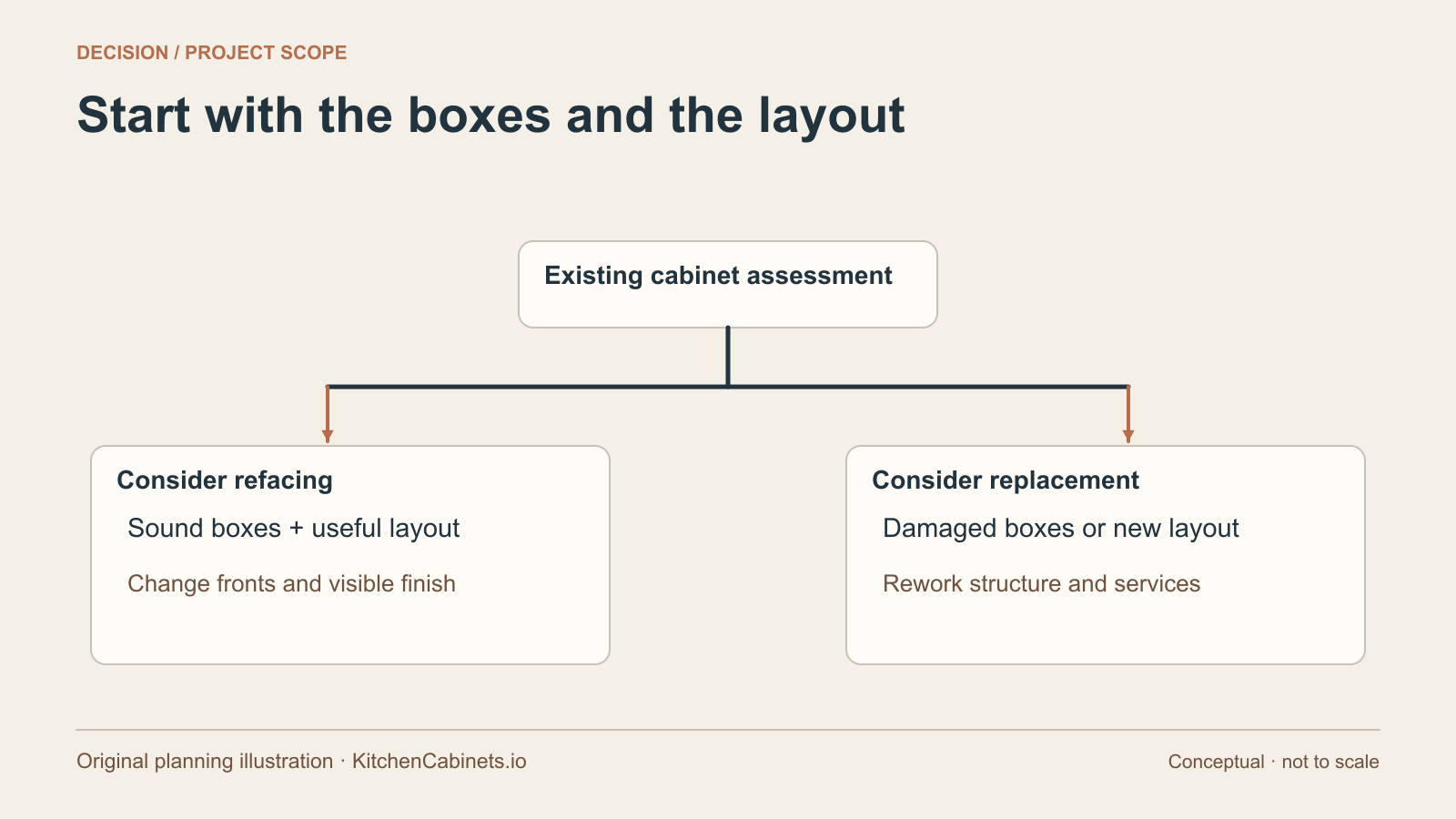
Refacing and replacement solve different problems. Refacing can change the visible fronts while retaining a useful cabinet arrangement. Replacement can change the underlying boxes, storage and layout. The right starting point is therefore not a photograph of a preferred door. It is an inspection of the kitchen you have and a clear description of what needs to work differently.
This guide helps organize that decision without promising a price, payback period or environmental result. Those outcomes depend on the actual scope, materials, local services and condition of the existing kitchen. A meaningful comparison should show which components remain, which are renewed and which unresolved problems would survive the work. New fronts can be a good solution, but they should not disguise a box that needs attention or preserve a layout the household no longer wants.
Define the change you actually need
Write down the problems before researching finishes. Separate appearance, operation, condition and layout. “The door colour is dated” is an appearance issue. “The drawer binds when loaded” is an operating issue. “The sink base has swollen at its lower edge” is a condition issue. “The dishwasher blocks the main route” is a layout issue. Several categories can occur together, but each needs its own response.
Now describe the desired result in observable terms. You might want doors that close reliably, drawers that hold heavy cookware, a less congested cleanup area and a different finish. This list becomes the basis for comparing proposals. It prevents the decision from narrowing prematurely to whichever supplier offers the most attractive door sample or uses the broadest description of a renovation package.
Consider two hypothetical households with visually similar kitchens. One likes the layout, uses the existing storage comfortably and has sound boxes; its main concern is worn fronts. The other wants to relocate cooking, replace inaccessible shelves with drawers and correct water damage. The same cosmetic treatment would have different value for those households because the problems being solved are different.
Understand what refacing retains
The Home Depot Canada's kitchen buying guide describes refacing around retaining the main layout and cabinet boxes while renewing visible elements such as doors, drawer fronts, hardware and trim. The exact service scope still needs to be written into the individual proposal. Some packages may include additional accessories or modifications; those should be listed, not inferred from the word “refacing.”
Ask what happens to the cabinet interiors, exposed ends, underside surfaces, toe area and the inside edges of openings. A new door can sit beside an older interior finish, which may be entirely acceptable if expected. It is less satisfying when discovered after installation. View a representative sample or completed example that shows the transition between retained and renewed surfaces.
Create a retention schedule. For each cabinet, mark the box, shelves, drawer boxes, runners, hinges and front as retained, renewed or subject to inspection. That schedule makes two proposals easier to compare. It also reveals whether the project is still a straightforward refacing job or has become a series of structural and storage modifications that deserve comparison with replacement.
Inspect boxes before choosing fronts
Look for movement, damaged joints, sagging shelves, loose mounting points, swollen panels and areas that have been repeatedly wet. Record observations without assuming their cause. A dark mark is not enough information to diagnose a concealed condition. A qualified person may need to investigate damage, moisture or the way a cabinet is supported before recommending a surface treatment.
Home Depot's refacing service guidance identifies warped, water-damaged or structurally unsound boxes as reasons to consider replacement. That is a useful screening principle rather than a remote diagnosis of your kitchen. The person quoting should inspect the actual boxes and explain which are suitable to retain. Ask for exceptions to be written into the proposal rather than covered by a general statement that the kitchen is “in good shape.”
Pay particular attention to cabinets around the sink and dishwasher, but inspect the entire room. A dry pantry cabinet can still have a failed shelf support or damaged hinge fixing. Conversely, a small localized issue does not automatically prove every cabinet must be discarded. The decision should connect the observed condition to a practical repair or replacement scope, with uncertainty clearly identified.
Find and address the cause of damage
If a sink base is damaged, changing its surface does not explain why it became wet. Have the relevant plumbing or appliance condition assessed and corrected as needed. Similarly, a recurring door alignment problem may involve a hinge, a damaged fixing point or a cabinet that is no longer properly supported. The repair depends on the cause, not just the visible symptom.
KraftMaid's care guidance emphasizes avoiding prolonged moisture exposure, including wet items left against cabinetry. This is useful for planning future care but should not be used to assume every damaged cabinet was mistreated. Document the current condition and ask the appropriate installer to check potential sources. Good decision-making separates what is observed, what is suspected and what has actually been confirmed.
A practical sequence is to investigate the source, agree on the remedy, assess the retained cabinet after that remedy and only then approve the finish work. This may seem slower than selecting a door immediately, but it prevents new surfaces from being installed over a continuing problem. Include responsibility for any concealed condition discovered during removal in the written project arrangements.
Test the layout you would preserve
Walk through daily tasks with the present kitchen. Where do groceries land? Where are dishes unloaded? Which drawers can open together? If refacing retains the layout, these relationships are likely to remain unless the proposal explicitly changes them. A successful refacing project can improve appearance while preserving a layout that already works; it should not be credited with solving circulation problems it does not address.
Try a simple dishwashing scenario. Open the dishwasher and the cupboard where plates belong. Stand where someone would normally unload. Then imagine the proposed new doors in place. If the conflict is unchanged, record it as a retained limitation. This does not necessarily rule out refacing; it gives the household a conscious choice about whether that limitation is acceptable.
If a different layout is important, ask a designer to develop a replacement option at a comparable level of detail. Avoid comparing a fully itemized refacing proposal against a vague idea of a completely new kitchen. Both options should identify affected appliances, counters, services, finishes and installation work. The larger scope of a layout change needs to be visible before comparing totals or disruption.
Evaluate storage improvements individually
Some retained cabinets may accept new fittings, but compatibility should be checked. An internal pullout depends on the usable opening, hinge projection, cabinet depth and fixing surfaces. A new runner system may require changes to the drawer box. “Add soft-close” is not a complete specification for turning every existing drawer into a modern loaded-storage system.
Choose a few high-value tasks to investigate rather than adding an accessory to every cabinet. A better cutlery drawer, accessible waste sorting or a usable saucepan drawer may matter more than several complex corner mechanisms. Ask the supplier to identify the exact product, installation requirements and effect on usable space. A fitting that looks impressive in isolation may reduce the room available for your actual belongings.
Compare the resulting assembly, not just the accessory price. If a drawer needs a new box, new runners, altered fronts and substantial cabinet work, include all those elements in the comparison. The project may still make sense, but its scope should be honest. Storage improvements are most useful when they solve a named problem and remain compatible with the retained cabinet.
Decide how much visual continuity matters
A renewed front and an older interior can create a deliberate, acceptable combination. It can also create a mismatch the owner dislikes. Examine door edges, open shelves, glass-front cabinets, exposed cabinet sides and the areas visible when doors are open. Ask how each will be treated. A small sample viewed flat on a table does not show the entire finished relationship.
Look at samples in the kitchen's actual light and beside the surfaces you will keep. Countertops, flooring and wall colour can influence how a finish appears. Do not use a phone image as the sole approval reference. Record the exact finish and product selection in the contract documents, including any expected variation, rather than approving an informal description such as “warm white.”
Door style can also expose practical questions. A different overlay or thickness may affect hinges, gaps and adjacent fronts. Ask the refacing contractor to explain those details using the proposed system. A visual change should be supported by a compatible opening and closing arrangement, not an assumption that every replacement door can be attached to every existing cabinet in the same way.
Compare complete scopes and exclusions
Request itemized descriptions for both options. Include removal, preparation, cabinet components, fronts, hardware, installation, finishing details and waste handling. Identify countertop and backsplash work, appliance handling and service changes where relevant. A proposal can be concise while still making its boundaries clear. The goal is to understand the result being purchased, not to insist on a particular quoting format.
Ask what is excluded and what could change after work begins. If the supplier cannot inspect a concealed condition until fronts or panels are removed, establish a process for documenting it and approving the response. That process should distinguish an included repair from a new charge. A low initial number with broad unresolved exclusions is difficult to compare against a more complete proposal.
Avoid universal claims that one option is always cheaper or faster. Refacing a straightforward, sound kitchen and extensively modifying a damaged one are different projects. Replacement also varies widely with layout, materials and service work. Compare actual written proposals for your kitchen, with the same retained appliances and finish assumptions where possible. That produces useful information without invented market prices.
Consider waste without inventing a footprint
Retaining serviceable boxes can avoid discarding those particular components. That straightforward observation does not establish a complete environmental comparison. New fronts, surface materials, adhesives, transport, installation waste and the expected service life all matter. Unless a project-specific assessment is available, avoid precise claims about carbon savings or a percentage reduction in environmental impact.
Ask what will actually happen to removed materials. Can usable components be donated or reused locally? Are recycling routes available for the specific materials? What does the contractor include in disposal? An intention to recycle is different from a confirmed receiving facility. Keep claims proportional to the evidence and choose practical waste-reduction steps that the project can document.
Durability also belongs in this discussion. Retaining a cabinet that is close to failure may mean repeating work sooner. Replacing a sound cabinet solely because it lacks a fashionable label can also create avoidable waste. The useful question is which components can provide reliable service in the intended layout, supported by an inspection and a realistic plan for repairs and maintenance.
Plan disruption and handover
Ask how the kitchen will be used during work, what needs to be emptied and where materials will be stored. Confirm how dust, finishes and access will be managed by the contractor. The answers are project-specific. A smaller physical scope may reduce some disruption, but it should not be described as effortless or guaranteed to finish in a particular number of days without a committed schedule.
At handover, open every door and drawer, inspect the agreed surfaces and compare the result with the retention schedule. Check that retained mechanisms still operate as expected and that renewed hardware is identified. Keep care instructions and warranty documents for the actual supplied products. A general website statement is not a substitute for the terms attached to your project.
The final decision can be summarized in three sentences: what is worth keeping, what must change and what problems each option leaves unresolved. If the boxes are sound and the layout works, refacing deserves serious consideration. If condition, storage or layout requires substantial reconstruction, replacement deserves an equally specific proposal. Choosing from that evidence is more reliable than treating either method as automatically superior.
Keep the decision record with the quotations. If the scope changes later, revisit the reasons for choosing the method rather than assuming the original conclusion still applies. A proposal that gradually adds new boxes, extensive repairs and service changes should be compared again with the replacement option using its updated scope.
Ask the contractor to identify one representative retained cabinet and describe exactly how its existing surfaces and mechanisms will meet the new work. Then ask the same question about the worst-condition cabinet. If the answers differ, put both scopes in writing. This small comparison can reveal a hidden assumption that every box has the same condition, even when the kitchen contains additions or repairs from different periods.
Sources and editorial notes
This is original explanatory reporting and planning analysis. Manufacturer documents support the specific product facts attributed in the guide; they do not imply affiliation. Sources were checked for this launch. The illustration was created for this article; it is not a photograph of a completed project.
- The Home Depot: Cabinet refacing services
- The Home Depot Canada: Kitchen buying guide, 2021
- KraftMaid: Cabinet care and cleaning
Corrections or a documented technical update? Email the editorial desk.