Buying Guide · Homeowners comparing cabinet proposals
How to compare cabinet quotes when the totals describe different kitchens
Compare cabinet quotations using matching drawings, material schedules, exact hardware and written inclusions.
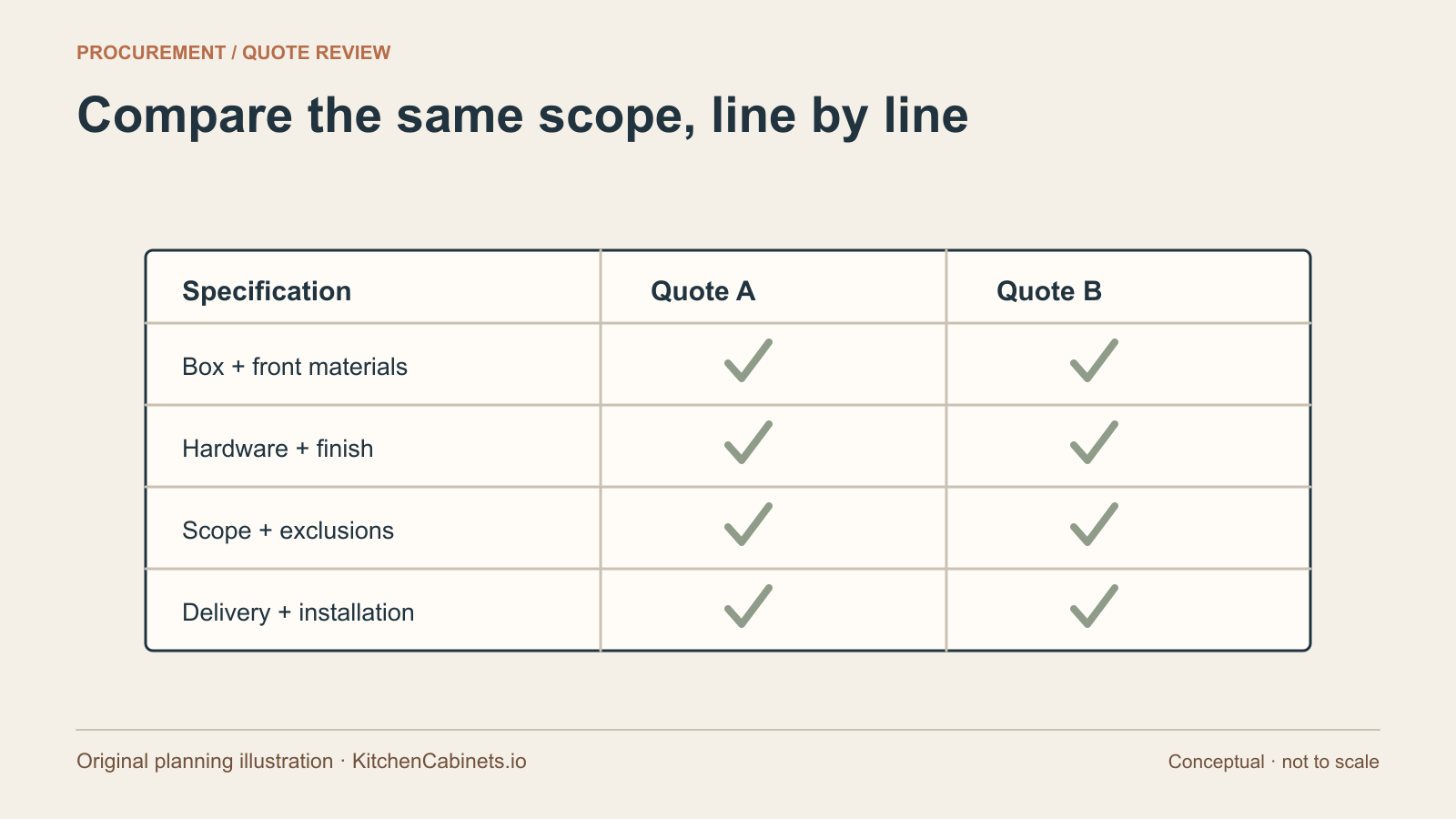
Start here
Two cabinet quotes can have different totals because one supplier is more expensive, because the products are different, or because the quotes do not include the same work. The total alone cannot distinguish those explanations. A useful comparison begins with a shared drawing and an agreed cabinet schedule, then separates materials, hardware, installation, site work and unresolved assumptions. That process gives a homeowner a way to discuss value without pretending that every difference can be reduced to a price per cabinet.
This guide provides a specification worksheet, not a price forecast or a recommendation to choose a particular company. KitchenCabinets.io does not verify a supplier's promises simply by discussing its quote. Ask each bidder to explain its own products and scope in writing. Where an answer depends on an appliance, room condition or another trade, identify who will supply that information and when the final cabinet decision will be made.
Issue the same starting information
The most useful quotation package includes the room dimensions, a drawing with numbered cabinet locations, the proposed appliance models and a short description of the intended work. Mark whether the layout is fixed or whether design development is part of the request. A supplier quoting a complete redesign is performing a different task from a supplier pricing a finished cabinet list. Give both companies the same starting point before comparing their totals.
Identify dimensions that are provisional. A room sketch prepared by the owner may be sufficient for an initial conversation, but it should not quietly become a final manufacturing drawing. Ask who will perform or approve the final site measurement, how discrepancies will be resolved and which dimensions are waiting for finished surfaces. Do not let an early estimate imply a level of certainty that the room information does not support.
Keep a revision number on the drawing and cabinet schedule. If the dishwasher moves, a tall cabinet is deleted or a door style changes, distribute the same revision to every supplier still being compared. Without that discipline, the most recent quote can appear expensive simply because it includes a change that the earlier quote never priced. A comparison works only when the inputs remain aligned.
Name the construction behind each visible surface
Ask each bidder to describe the cabinet box, back, shelves, drawer boxes, fronts and exposed panels. The description should identify materials and relevant thicknesses or product specifications rather than rely on broad words such as premium or custom. A painted door does not tell you how the box is made, and a plywood box does not tell you the construction of a drawer or the treatment of its exposed edges.
Use the manufacturer's current product documents to clarify the description. KraftMaid, for example, provides product specifications, hardware literature and installation and care resources separately. That is a useful model for the information to request from any supplier: the appearance brochure is only one part of the evidence. If a quote references a particular cabinet line, ask for the documents for that line rather than a brochure containing a wider range of products.
Include the less prominent surfaces that can change a quote: the back of an island, the ends of a tall run, filler strips, toe kicks and trim. Identify whether interiors have the same finish throughout and whether visible ends are factory-finished or treated on site. These are not minor details when they affect the amount of material, finishing work or installation labour required to deliver the agreed appearance.
Put hardware in the schedule, not in a vague allowance
List the opening and storage hardware for each cabinet where the choice matters. For drawers, ask for the runner or box-system name, the relevant model or series, the proposed length and the intended opening method. For doors, identify hinges and any special opening restriction. For a waste unit, corner mechanism or pantry pullout, identify the complete accessory and which components are included in the quote.
The point is not to turn every homeowner into a hardware engineer. It is to prevent two visibly similar drawers from being treated as identical when their construction and hardware are different. A showroom sample can help you understand the feel of a system, but the final schedule still needs enough information for the supplier and installer to order and fit the correct components. Brand names without a model or configuration can leave important questions unanswered.
Ask how substitutions are handled. If a selected runner or accessory becomes unavailable, the supplier should explain the proposed replacement and its consequences before it is installed. Check compatibility, appearance, adjustment, removal and documented performance rather than accepting equivalent as a complete answer. Record an agreed substitution beside the affected cabinet number so that the final order and handover documents remain useful.
Separate included work from coordinated work
A cabinet quotation may include cabinet installation while excluding demolition, wall repair, plumbing, electrical work, flooring, countertops or appliance installation. Another supplier may coordinate some of those tasks but use separate trades and separate invoices. Neither approach is automatically better. The comparison needs to show where responsibility starts and stops, particularly at the points where one task depends on another.
Make a scope table with three categories: included, excluded and unresolved. Assign each item to a named party where possible. For example, identify who removes existing cabinets, who prepares the wall condition for installation, who confirms the appliance dimensions and who arranges the final countertop measurement. If the answer is the homeowner, that should be visible before the schedule is agreed, not discovered when an installer arrives.
Ask whether delivery, carrying materials into the room, protection of existing finishes, waste removal and final adjustment are included. Access conditions can affect the work even when the cabinet list does not change. Describe stairs, elevator arrangements, parking restrictions or a narrow delivery route accurately. The supplier needs an opportunity to assess those conditions rather than being expected to absorb an assumption that was never discussed.
Compare documented performance without overreading a label
Certification can be useful evidence, but only if the claim matches the proposed product. KCMA's A161.1 Quality Certification concerns cabinet performance testing. If a supplier refers to that program, ask which cabinet line is covered and how the claim can be checked. Do not assume that a company's logo, a supplier's membership in an association or a statement about one component establishes certification for every cabinet being quoted.
Keep different claims in separate rows. Product durability, wood sourcing, composite-wood emissions and warranty terms answer different questions. A sourcing label does not tell you whether a particular drawer arrangement has been selected appropriately. A warranty does not replace the need for correct installation and care. Comparing these claims side by side is more informative than giving one quote an undefined quality score because it contains more badges.
Ask the supplier to show how its documented product characteristics relate to the actual project. If the room has a demanding sink area or a frequently used heavy drawer, discuss those conditions directly. Avoid inventing a test for the supplier to pass on the spot or treating a promotional demonstration as a substitute for product documents. The useful outcome is a clear specification and an appropriate installation, not a contest of marketing adjectives.
Treat dates and dependencies as part of the quotation
Ask what each stated date means. A manufacturing lead time may begin after a drawing is approved, after a deposit is processed or after a material becomes available. A delivery date is not necessarily an installation start date. A cabinet installation may need to pause while another trade completes work. These distinctions affect the household's experience even when the quoted cabinet total remains unchanged.
Build a short dependency list instead of relying on one promised completion date. Identify final measurement, drawing approval, material confirmation, site readiness, delivery, installation, countertop coordination, appliance work and final adjustment. Ask which dates are confirmed and which are estimates. If the project changes, update the dependency list with the revised drawing so that everyone is working from the same expectations.
Discuss how an unexpected condition will be reported and priced. A useful process identifies the issue, the affected work, the proposed solution and any effect on the schedule before the change proceeds. This is a practical coordination question rather than a substitute for reviewing the supplier's contractual terms. If a term is unclear or has significant consequences, obtain appropriate advice instead of assuming that a friendly conversation overrides the written document.
Work through an example without inventing a fair price
Imagine two quotes for the same apparent kitchen. Quote A includes painted doors, a laminate island end, ordinary shelving in the pantry and delivery to the room. Quote B includes a different island panel construction, a specified pantry mechanism, two waste containers and removal of installation debris. The totals differ, but there is no reliable way to identify the better value until those differences are listed and assessed against the household's requirements.
Create a comparison row for every difference. Ask Quote A's supplier to price the specified pantry and waste arrangement if those items are genuinely wanted. Ask Quote B's supplier whether a simpler pantry would meet the inventory and access needs. Keep the material difference on the island separate from the accessory difference. A single adjusted total can hide the fact that one change is essential and another is optional.
The exercise might reveal that the household prefers Quote A's finish but needs some of Quote B's clearly described scope. It might also reveal an unresolved appliance panel or a missing filler in both quotes. Those discoveries are valuable before ordering. The objective is not to force two companies to produce identical prices; it is to understand what each is offering and which unresolved items still prevent a confident choice.
Make allowances and exclusions visible
An allowance should be described well enough that you can understand what decision remains. Ask whether it covers material only, a complete accessory, installation or another defined scope. A number without that context is difficult to compare. Similarly, an exclusion should explain which work is outside the cabinet supplier's responsibility and whether the cabinet installation depends on that work being completed by someone else.
Do not count the same item twice when building a project budget. A countertop may be listed in one supplier's total and obtained separately for another quotation. An appliance panel may appear in a cabinet schedule while its installation is assigned elsewhere. Record the item once, identify the responsible party and keep the source of the amount with the comparison. This makes the total more useful without pretending that the cabinet quote covers the whole renovation.
Review the effect of optional choices separately. Decorative panels, interior organizers and a different door construction may all be reasonable upgrades, but they should compete against the household's actual priorities. Keep a base specification that meets the agreed requirements, then list optional alternatives with their own descriptions. This is clearer than allowing an attractive accessory package to obscure a missing installation task or an unresolved dimension.
Approve the final schedule rather than a remembered conversation
Before committing to an order, reconcile the selected quote with the latest drawing and cabinet schedule. Check cabinet numbers, quantities, door style, finish, exposed panels, hardware, accessories, appliance coordination and installation scope. Confirm that accepted substitutions and clarified exclusions are reflected in the final documents. A supplier cannot reliably build from a detail that exists only in somebody's memory of a meeting.
Keep the final package accessible during installation and handover. It should allow an owner or installer to answer straightforward questions about what was ordered without searching through a long email thread. If a delivered item differs from the schedule, identify it by cabinet number and product description before a permanent change is made. That record also helps distinguish a genuine discrepancy from a detail that was approved in a later revision.
The best comparison is one that leaves fewer surprises, not simply one that produces the lowest apparent total. A clear quote makes the product, work and remaining decisions understandable. Use that clarity when discussing a local cabinet project through a city page or requesting an email-draft quotation: provide the same information, ask the same questions and compare the same scope. The result is a decision based on the kitchen you intend to receive.
Confirm what the accepted revision replaces
When a supplier issues a revised quote, ask whether it replaces the entire earlier proposal or changes only named items. Save the accepted drawing and inclusion schedule with that version. A lower total can otherwise be compared with an older, more complete scope by accident. Check the removal of an allowance as carefully as the addition of a feature: responsibility may have moved to another party rather than disappearing. Give each unresolved item a named next step and request an answer before the order is treated as final. This creates a common reference for later conversations without relying on everyone's memory of a showroom discussion.
Sources and editorial notes
This is original explanatory reporting and planning analysis. Manufacturer documents support the specific product facts attributed in the guide; they do not imply affiliation. Sources were checked for this launch. The illustration was created for this article; it is not a photograph of a completed project.
Corrections or a documented technical update? Email the editorial desk.