Storage and hardware · Homeowners specifying practical kitchen drawers
Drawer Hardware: Compare the Loaded Drawer, Not Just the Soft-Close Label
Evaluate drawer runners, load ratings, box construction, opening technology and handover as one working system.
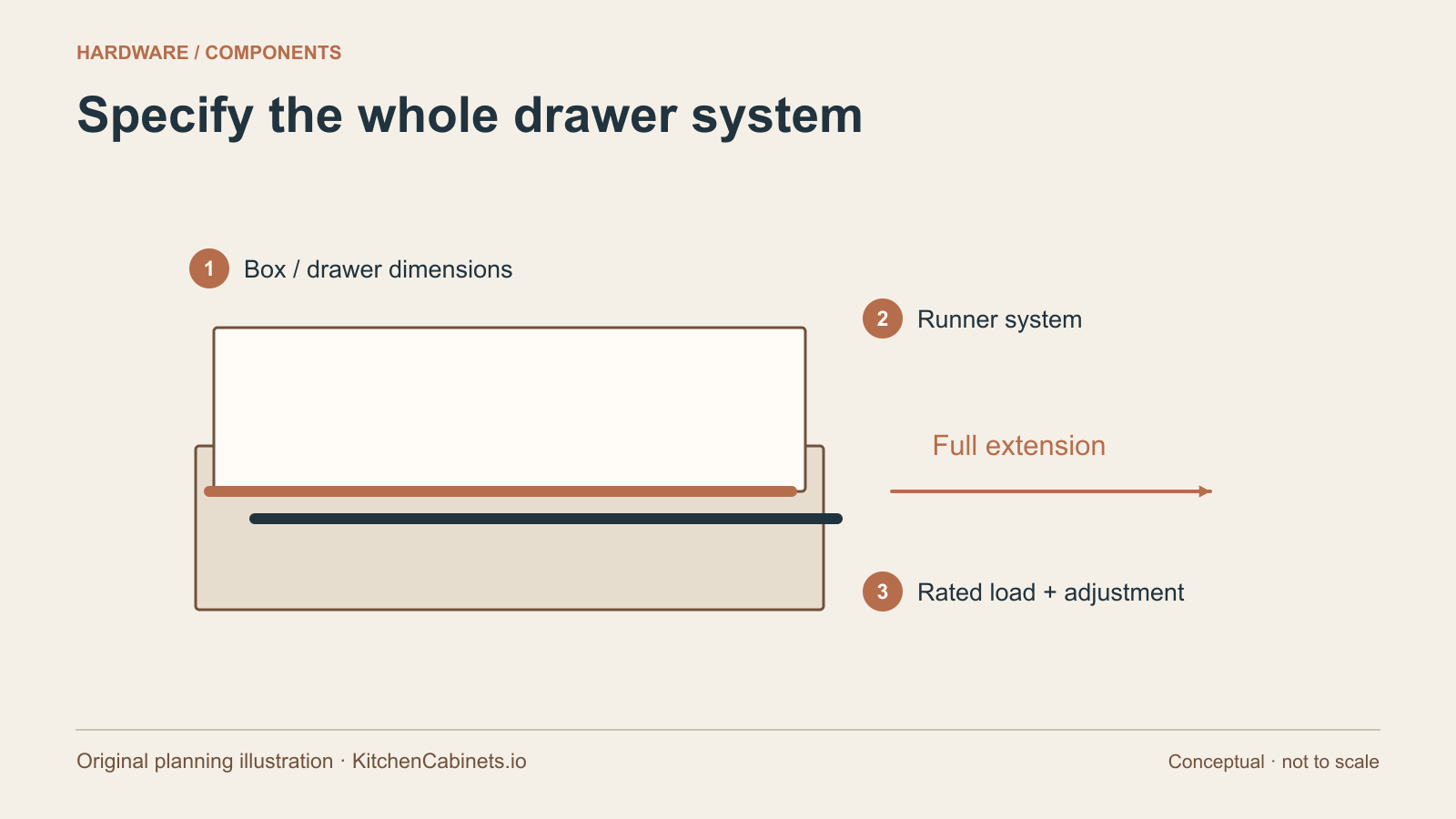
Start with the practical decision
A drawer can feel excellent when it is empty and still be the wrong choice for the cookware, dishes or small appliances you intend to store. Soft closing describes one behaviour, not the entire system. Useful questions concern the runner model, usable opening, load class, drawer-box construction, installation and adjustment. Ask those questions while the kitchen is being specified, when a supplier can change the arrangement without rebuilding an installed cabinet. The goal is a drawer that works for its assigned contents, not a collection of hardware features that sound impressive in a brochure.
Start by making an inventory of the demanding drawers in your proposed kitchen. A shallow utensil drawer, a wide pan drawer and a pull-out waste unit have different contents and patterns of use. Identify the unusually heavy, tall or awkward objects, and decide where you want them. Then ask the cabinet supplier to identify the exact hardware and drawer assembly proposed for each location. A familiar brand name is a starting point for finding technical information; it does not establish that every runner from that brand has the same load capacity, extension or fitting requirements.
Identify the complete runner system
Ask for the product family and model or part designation, not merely “premium slides.” Blum's MOVENTO programme, for example, includes full-extension runners in different nominal lengths and load-bearing capacities. Its published programme identifies 40-kilogram and 70-kilogram options. Those are examples within that manufacturer's system, not universal drawer ratings and not automatic capacities for any cabinet using a Blum component. The quoted runner, drawer box, fixing method and installation must be considered together. Retain the relevant product documentation with the cabinet order rather than relying on the label attached to a showroom drawer.
Check whether the drawer being demonstrated is the one you will receive. Displays can combine upgrades, different heights and different operating technologies. Ask the supplier to mark any difference on the quotation. A wide display drawer might use a higher load class than the narrower drawer included in a basic package; a demonstration of push-to-open might not apply to the soft-close system being priced. Make those distinctions explicit. It is easier to compare two named systems than two broad promises that both use words such as smooth, heavy-duty and luxury.
Read the load rating in its proper context
Find out exactly what the manufacturer's rating measures and which assembly conditions apply. Ask whether the stated load includes the weight of the drawer itself, what nominal lengths are offered in that class, and whether the proposed drawer width or construction changes the specification. Blum's technical catalogue provides product-specific ordering and planning information; use the documentation for the actual runner rather than multiplying a marketing number by the number of drawers. Do not treat a runner's capacity as a reason to load a cabinet beyond the cabinet manufacturer's own limits.
Create an illustrative loading list for a pan drawer: the drawer assembly, cookware, lids and any internal organiser all contribute to the load that the system must carry. You do not need to calculate a structural design yourself. Weighing the actual contents, or asking the supplier to assess them, can make the conversation concrete. If a supplier recommends a different runner class, ask why and record the revised specification. Avoid assuming that the next higher rating is automatically necessary or that the lowest-priced runner is sufficient simply because the drawer closes when empty.
Distinguish extension from usable access
Full extension is valuable when it allows a user to see and reach the back of a drawer, but the complete installation must still provide the intended travel. Look at the drawer fully open, with a representative item inside. Check whether an adjacent handle, wall, appliance or door restricts access. A full-extension runner cannot solve a collision elsewhere in the layout. Ask the designer to show the open positions of drawers near corners, islands and appliances, and use the actual hardware planning information rather than assuming every drawer will operate independently of its neighbours.
Usable drawer depth is also different from nominal runner length and outside cabinet depth. The drawer box, rear clearances, service space and front arrangement can affect what fits. Measure the inside space that will actually hold your belongings. A baking tray or large lid may be too tall when stored upright even though it fits flat. A mixer may fit the drawer's footprint but exceed its usable height. Resolving those questions before ordering is more useful than comparing the number of drawers shown on two kitchen elevations without examining their interiors.
Compare the drawer box and bottom with the runners
The runner is only one part of the load path. Ask about drawer-side material, bottom construction, joints and the method of fixing the assembly to its hardware. A high-capacity runner does not establish the suitability of an unrelated drawer bottom or an improvised installation. KCMA's cabinet construction and performance standard evaluates assembled cabinetry through defined requirements and tests. That performance-oriented approach is helpful: request evidence about the actual cabinet and drawer system rather than treating one upgraded component as proof of the entire assembly's strength or durability.
Inspect a representative drawer underneath if the supplier can safely demonstrate it. Ask where its adjustments and release mechanisms are located and whether removing the drawer requires a particular procedure. Do not pull or force a display component to discover the answer. A supplier should be able to explain the system and identify the correct instructions. If different drawer-box options are available, compare them at the same width and intended load. Otherwise, a choice presented as a material upgrade may also change the available inside space, hardware or service method in ways you have not considered.
Separate closing technology from opening effort
Soft close, push-to-open and assisted opening are different functions, and manufacturers offer different combinations within their product ranges. Blum notes that MOVENTO can be paired with several of its operating technologies. Ask the supplier to identify the exact combination and demonstrate how it behaves in the proposed application. Do not assume that adding push-to-open is simply a matter of removing a handle. The system may require specific fittings, planning or adjustment, and its behaviour should be evaluated by the people who will use the kitchen rather than chosen only for a clean-looking elevation.
Try the drawer from normal working positions. Consider wet hands, one-handed use and the grip available on a proposed pull. A demonstration should reveal whether opening is comfortable, whether the closing action is predictable and whether a person can reach the contents without awkward movement. This is not a medical or accessibility assessment; users with particular access needs should review the arrangement with the appropriate professional. Avoid assuming that a heavier drawer or a longer handle suits everyone. A kitchen should be specified around real tasks and users, not solely around the way an empty display moves.
Plan wide drawers as deliberate storage choices
A wide drawer can organise cookware efficiently, but width alone does not make storage convenient. Decide which objects belong together, how they will be separated and whether the drawer will be opened while someone works nearby. Ask about the cabinet manufacturer's limits for the proposed width and height, together with the runner and drawer-box specification. If the design needs stabilising components or a particular installation arrangement, include them in the order. Do not assume that a runner with a higher load rating eliminates every concern created by a very wide front or a heavily filled drawer.
Consider a hypothetical two-drawer cooking zone. One large lower drawer might hold stockpots and pans, while a shallower upper drawer holds the tools used with them. Another household may prefer narrower drawers that separate baking equipment from everyday cookware. Neither arrangement is inherently better. Test the planned contents and identify how each drawer will be used during a meal. An attractive deep drawer can become a stack of difficult-to-lift items if the internal organisation is not considered. Drawer hardware should support the storage plan; it should not be used as a substitute for one.
Look at internal drawers and door clearance together
An internal drawer behind a hinged door needs enough unobstructed access to open correctly. The door, hinge and pull-out system therefore need to be designed as a combination. Ask the supplier to show the required opening condition and demonstrate it on the actual cabinet configuration. Hinge protrusion and opening angle can matter, particularly beside a wall or another cabinet. Blum's technical catalogue includes planning details for specific applications; that is the right level of information for resolving a conflict, rather than a generic statement that concealed hinges should provide sufficient clearance.
Do not approve a pantry drawing that shows only closed fronts if internal pull-outs are important to its function. Ask for an open-view detail or a practical demonstration. Confirm whether any filler, hinge restriction or special fitting is included, and check that the chosen arrangement does not make another drawer inaccessible. The same principle applies to waste pull-outs and sink-adjacent storage. Pipes, bins, door mechanisms and cleaning products compete for the same space. An organiser should be selected after those constraints are understood, not added to a quotation because it fits the nominal cabinet width.
Keep installation and adjustment within the product system
Ask who will install and adjust the hardware and which instructions they will follow. The system may offer several adjustment directions, but those adjustments have a defined purpose and range. They are not a substitute for a cabinet that has been fitted incorrectly or a drawer built to incompatible dimensions. Dura Supreme's installer resource library, for example, separates drawer and hinge adjustment information from broader cabinet installation guides. Use the documents belonging to the actual cabinet and hardware, and ask the installer to resolve any persistent binding or misalignment rather than forcing a drawer to operate.
Record a handover check for each demanding drawer. Open it fully, close it normally and inspect the front alignment and nearby clearances with its intended contents considered. Ask the installer to demonstrate safe drawer removal if that is part of normal maintenance, and retain the instructions. If a drawer will not operate correctly, document the condition before treating it as ordinary wear. A clear product identifier, installation date and description of the problem will be more useful to a service team than a general complaint that the kitchen's soft-close hardware feels wrong.
Evaluate maintenance and replacement before purchase
Find out how replacement runners, locking devices or adjustment parts are obtained for the quoted system. Ask whether the cabinet supplier provides service directly or directs the owner to the hardware manufacturer. Keep the cabinet order and hardware specifications together. A drawer front's appearance may remain familiar for years while the mechanism underneath is difficult to identify. Knowing the product family from the start helps a future technician find the correct instructions and parts without relying on visual similarity or a possibly incorrect substitute purchased online.
Follow the manufacturer's care and adjustment guidance rather than applying a generic lubricant or cleaner. A household tip that suits one mechanism may be unsuitable for another. Ask the supplier what normal maintenance is expected and what signs indicate that service is needed. Treat warranty language as product-specific: obtain the written terms and understand the relevant exclusions. A long warranty does not establish that any load, installation method or replacement part is acceptable. Good specification is about matching the system to the task and preserving the information needed to keep it working.
Build a quotation that names the demanding details
For each important drawer, record its intended contents, usable inside dimensions, drawer-box construction, runner designation, load class, extension and operating technology. Ask suppliers to identify exclusions and substitutions. A quotation that simply says “soft-close drawers throughout” leaves most of those choices open. If the hardware changes during ordering, revisit the affected dimensions and operating requirements rather than accepting a new name as equivalent. Use KitchenCabinets.io's retained city pages to organise local discussions, while checking each supplier's own product and installation information independently.
The best drawer demonstration is one tied to your kitchen. It shows how the actual assembly will support its contents, open in its surroundings and be installed and serviced. A familiar brand and a reassuring closing action can both be useful, but neither replaces that examination. Compare the loaded drawer, the available space and the complete specification. Then retain the documents and check the handover against them. That approach gives hardware a clear job and makes it easier to identify whether the finished kitchen provides the performance that was actually agreed.
For a final specification check, choose one demanding drawer and trace every named component from the quotation to the drawing. Identify the runner, drawer box, front, fixing method and any opening accessory. Ask who confirms the completed assembly's intended load and who addresses a problem after installation. If the answers point to several suppliers, establish a single project contact. That coordination is especially useful when an accessory upgrade changes the original drawer specification after the initial cabinet quote.
Sources and editorial notes
This is original explanatory reporting and planning analysis. Manufacturer documents support the specific product facts attributed in the guide; they do not imply affiliation. Sources were checked for this launch. The illustration was created for this article; it is not a photograph of a completed project.
- Blum: MOVENTO programme and product options
- KCMA: ANSI/KCMA A161.1–2022 Performance and Construction Standard
- Dura Supreme: Installer guides
Corrections or a documented technical update? Email the editorial desk.