Materials & Finishes · Homeowners selecting cabinetry
Cabinet finishes: choose the care routine before you choose the colour
Compare cabinet finishes through actual surface care, moisture exposure, samples and replacement planning.
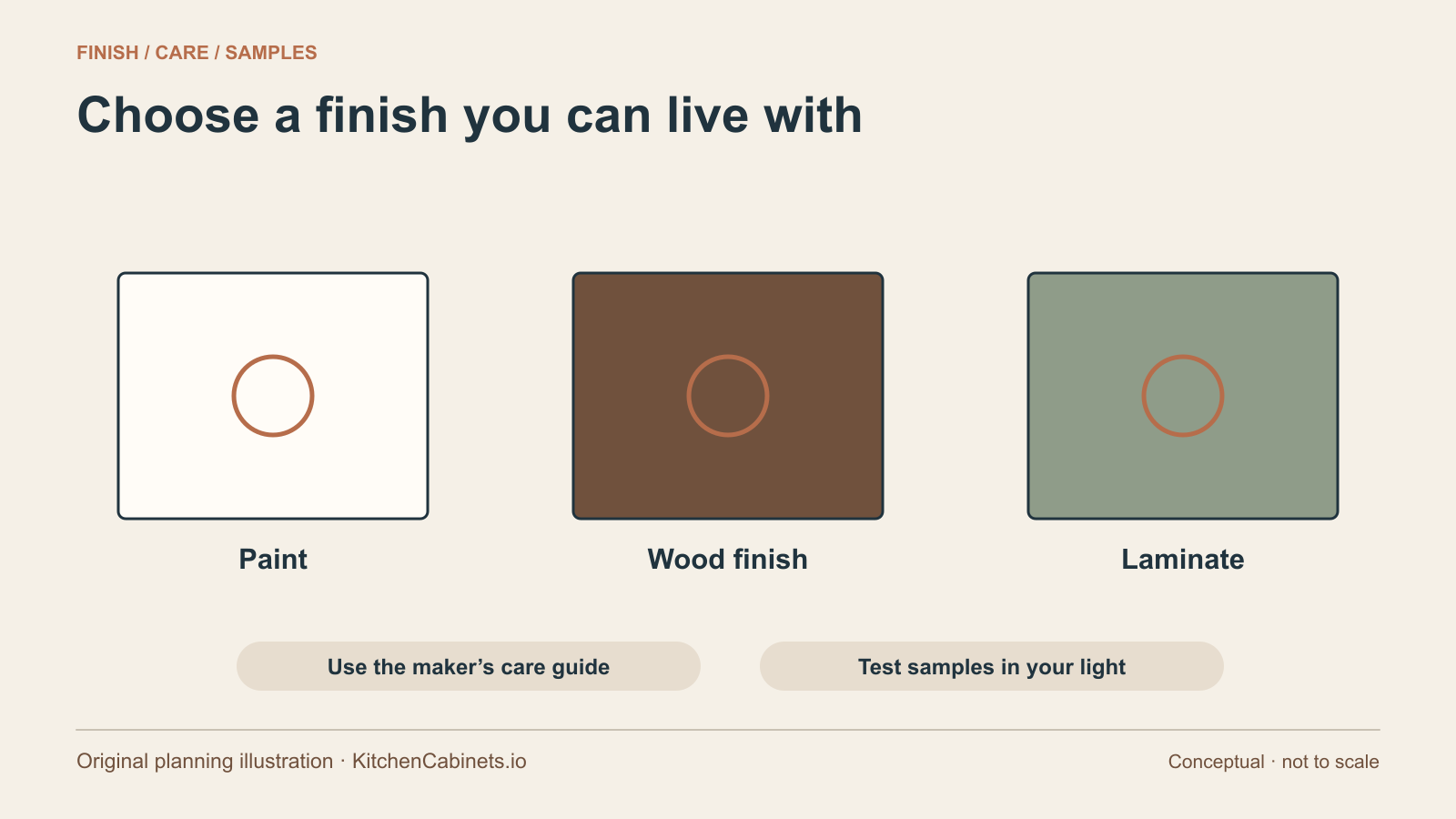
Start here
Two cabinet doors can look almost identical in a showroom and ask for very different treatment at home. A painted wood door, a decorative laminate door and a textured laminate panel may all be described as easy to clean. That phrase does not tell you which cleaner to use, how to deal with a wet seam, or whether a damaged edge can be repaired locally. A useful finish decision includes the cleaning instructions, the construction behind the surface and a realistic plan for the places that get wet or hot.
This guide is a way to compare those details before ordering. It is not a claim that KitchenCabinets.io manufactures any particular finish, holds a certification or supplies the products discussed. Manufacturer care instructions for the exact ordered product should take priority over general household cleaning advice. Keep the product name and instructions with the final cabinet schedule, rather than trying to reconstruct them when a cleaner damages a door several years later.
Start with the surface you will actually touch
Ask a supplier to identify the finish in writing. Useful descriptions name the door substrate, the face material or coating, the edge treatment and any different material on the back. Painted, laminate and woodgrain are appearance categories, not complete specifications. The word matte describes reflectance, not the chemical composition of the finish. Likewise, a wood look might be timber veneer, printed decorative paper, laminate or another construction. Those alternatives can be sensible choices, but they are not interchangeable when cleaning or repairing them.
Use a simple sample record. Put the supplier's product code, colour code, sheen, door construction and proposed handle beside a sample. Add the cleaning document's title or web address. If a salesperson recommends a particular polish, ask them to identify where the finish manufacturer permits it. A verbal recommendation that conflicts with the written instructions should be resolved before purchase. The goal is not to collect a binder of advertising; it is to make sure everyone is discussing the same material.
Check whether exposed end panels, fillers, toe kicks and decorative mouldings use the same finish as the doors. A project can combine several surfaces that need different treatment. A timber feature panel beside painted cabinetry deserves its own care line. Recording those differences also helps the installer avoid using an unsuitable cleaner across the entire kitchen during handover.
Compare cleaning instructions, not cleaning slogans
KraftMaid's published Care and Cleaning guidance for its wood cabinetry stresses controlling moisture and drying the surface after cleaning. It also distinguishes cleaner types and warns about wax buildup and silicone products. Those instructions are useful evidence of why a generic furniture polish should not automatically become a universal cabinet cleaner. They describe KraftMaid's products, however, and should not be stretched into a cleaning guarantee for every painted or veneered cabinet on the market.
Formica's care and maintenance guidance describes a different routine for its laminate products: a damp nonabrasive cloth and a suitable mild cleaner, followed by rinsing and drying. It specifically cautions against flooding laminate near seams because water can enter and affect the substrate. Its portfolio includes different surfaces with their own guidance. A technique documented for one Formica surface is not automatically appropriate for another, still less for a cabinet coating made by a different company.
When comparing two finishes, write down their ordinary routine in three lines: what to use, what to avoid and what to do after a spill. If the supplier cannot provide those basics, the specification is incomplete. You do not need an elaborate cleaning ritual, but you do need instructions that match the purchased surface and can be followed by everyone who uses the kitchen.
Test a sample against ordinary life
A sample is more useful when viewed in the actual room. Look at it in daylight, with the proposed task lighting on and under evening lighting. A low-sheen finish can change its apparent texture depending on where light strikes it. A pale painted door may look warmer beside a timber floor than it did in a showroom. The purpose of this check is to prevent an expensive mismatch, not to decide which colour is fashionable.
Handle the sample with clean hands, then look for ordinary fingerprints from several angles. If the manufacturer provides a recommended cleaning method, use that method on the sample and assess the result after it dries. Do not conduct a destructive chemical or heat experiment on a showroom sample without permission. A deliberately harsh test can create damage that has little relationship to normal use and can give a misleading impression of the product.
Compare samples at a similar scale and with the proposed handle. A handle changes how often hands touch the door face. A very small knob may concentrate contact around one location; an integrated grip can put hands directly on an edge. Neither arrangement is inherently wrong. The right question is whether the finish, opening method and household routine make sense together.
Give the sink and dishwasher their own review
The sink area deserves more attention than the middle of a dry pantry run. Identify seams, exposed edges, plumbing penetrations and places where wet hands are likely to touch the door. Look at how the countertop edge sheds water and whether a splash can remain against the upper edge of a cabinet front. A water-resistant face does not make every joint, fixing or substrate in the assembly waterproof.
KraftMaid's care guide specifically draws attention to moisture around the sink and dishwasher and warns against leaving wet towels on a cabinet door. That is a useful prompt for layout planning: decide where towels will dry without resting against a finished panel. A suitable hook, rail or another ventilated location can be easier to use than relying on everybody to remember not to drape a towel over the nearest door.
During the design review, ask how a sink leak would be noticed and how the base could be inspected. Keep service access practical rather than filling every cavity with a storage mechanism. If a leak occurs, address the plumbing problem and dry the affected assembly promptly; a cosmetic touch-up is not a substitute for fixing water entry. Product-specific repair decisions belong with the supplier or an appropriate trade professional.
Treat appliance heat and steam as specification questions
Before settling on door and panel materials beside an oven, dishwasher, kettle or another heat-producing appliance, gather the relevant appliance installation instructions. The cabinet drawing should coordinate with those documents. A finish sample sitting comfortably on a desk tells you nothing about the assembly's suitability beside a particular appliance. Ask who is responsible for confirming compatibility and where that confirmation is recorded.
Do not assume that an accessory intended to manage heat removes the need to follow an appliance's clearance and ventilation requirements. KraftMaid discusses a heat-shield accessory in its care material, but that does not establish a universal solution for every oven cabinet. The ordered cabinet construction, the appliance model and the installation detail still matter. A manufacturer-specific accessory is something to investigate, not an excuse to improvise.
Think about countertop appliances after the permanent equipment has been coordinated. A kettle that routinely releases steam against the underside of a wall cabinet creates a predictable use pattern. Discuss a convenient place for it that respects the appliance instructions and keeps the cabinet surface from repeated exposure. A practical layout is more dependable than a care instruction that requires moving several objects every morning.
Decide what a repair would involve
Ask a different question from whether the finish is durable: if one door or exposed panel is damaged, what is the likely repair route? The answer may involve a manufacturer touch-up product, replacement of the front, refinishing by a specialist or replacement of a larger assembly. Do not assume that every finish can be invisibly repaired on site, or that a replacement ordered years later will be visually identical to a surface that has aged in the kitchen.
Request the procedure for obtaining replacement parts. Keep the cabinet line, colour, door style and product identifiers, as well as the order documentation. If repair materials are supplied at handover, label them and store them according to their instructions. An unmarked bottle in a drawer is not a useful maintenance plan. Some materials have storage limits or application requirements, and the owner should not be left to guess what they are.
Distinguish ordinary finish variation from damage using the supplier's written standards and approved samples. Review a concern in the installed lighting and document it clearly. A photograph of the entire cabinet run plus a close-up is usually more informative than a tightly cropped image without location or scale. Ask the supplier to propose an appropriate remedy before attempting an irreversible repair yourself.
Build a finish schedule that can survive a substitution
Consider a kitchen with painted perimeter doors, a timber-look island and laminate interiors. The first quote might list all three as a single colour scheme. A more useful schedule has a separate row for each visible and high-use material. Each row names the construction, appearance, cleaning document, sample approval and replacement-part reference. That schedule makes a proposed substitution visible instead of allowing the word equivalent to hide a different product.
If a supplier proposes a substitute because the original material is unavailable, compare more than colour. Ask whether the edge construction, cleaning instructions, sheen, repair route and warranty terms change. Check a new sample in the room. A substitution may be perfectly reasonable, but it is a new decision with consequences that should be acknowledged before manufacture or installation.
Use the same schedule when comparing cabinet quotes. One supplier may be quoting a different panel on the island ends or a different construction for the tall oven surround. Those differences can explain a price change without making either quote dishonest. Clear material descriptions allow a fair comparison and help you decide where a change is acceptable and where the original specification should remain.
Make the handover routine short and usable
A finish handover should leave the owner with the final material schedule and the exact care documents, not simply a general instruction to use a damp cloth. Ask the supplier to identify any cleaning materials used during installation and any surfaces that still require special treatment. Record the location of spare parts and touch-up products, and ask what to do if a finish concern appears during the initial period of use.
For a shared household, write a small care note in ordinary language. It might identify the approved everyday cleaner, remind people to dry wet surfaces and list products that should not be used. Keep this note with the actual manufacturer instructions so that simplifying the routine does not erase important limits. Cleaning staff or visitors should not have to infer the finish type from its appearance.
Review the first few weeks of use. If water repeatedly pools in one place, or a handle makes a frequently used door awkward to open without touching its edge, discuss the underlying detail. Maintenance should not become a way to excuse a poor installation or an impractical layout. A finish that fits the room, the opening method and the household's habits is a more useful choice than one selected on colour alone.
What to bring to the next cabinet conversation
Bring the room measurements, appliance model information, a short list of finish candidates and a description of how the kitchen is used. Include the places that are likely to be wet, hot or heavily handled. Ask the supplier to turn those observations into product-specific recommendations and a written schedule. If you are comparing suppliers through a local planning page such as Vancouver, keep the technical finish questions the same so the location discussion does not replace specification work.
Before signing off, you should be able to identify every major cabinet surface, explain its ordinary cleaning routine and describe where its care instructions are stored. You should also know who will respond if a product is damaged, substituted or unexpectedly difficult to maintain. That is a stronger basis for a finish choice than a promise that everything is low maintenance. The right finish is one whose appearance, construction and care requirements you understand before it becomes part of the room.
Record a small cleaning trial before committing
If the supplier permits a cleaning trial on a sample, document the surface name, approved cleaner, cloth and method used. Check the sample in the light where it will be installed after it has dried. The purpose is to understand the routine and appearance, not to perform an improvised chemical-resistance test. Do not expose a sample to substances the manufacturer prohibits and then infer how the ordered kitchen will perform. Keep the sample label and care reference together so a later finish substitution cannot quietly inherit the earlier trial's result. Ask the supplier to clarify any change in care requirements before accepting the replacement.
Sources and editorial notes
This is original explanatory reporting and planning analysis. Manufacturer documents support the specific product facts attributed in the guide; they do not imply affiliation. Sources were checked for this launch. The illustration was created for this article; it is not a photograph of a completed project.
Corrections or a documented technical update? Email the editorial desk.