Buying Guide · Homeowners and specifiers reviewing product claims
Cabinet certifications: what KCMA, FSC and TSCA claims actually help you decide
Separate KCMA performance, FSC sourcing and TSCA composite-wood claims with a product-specific evidence register.
Start here
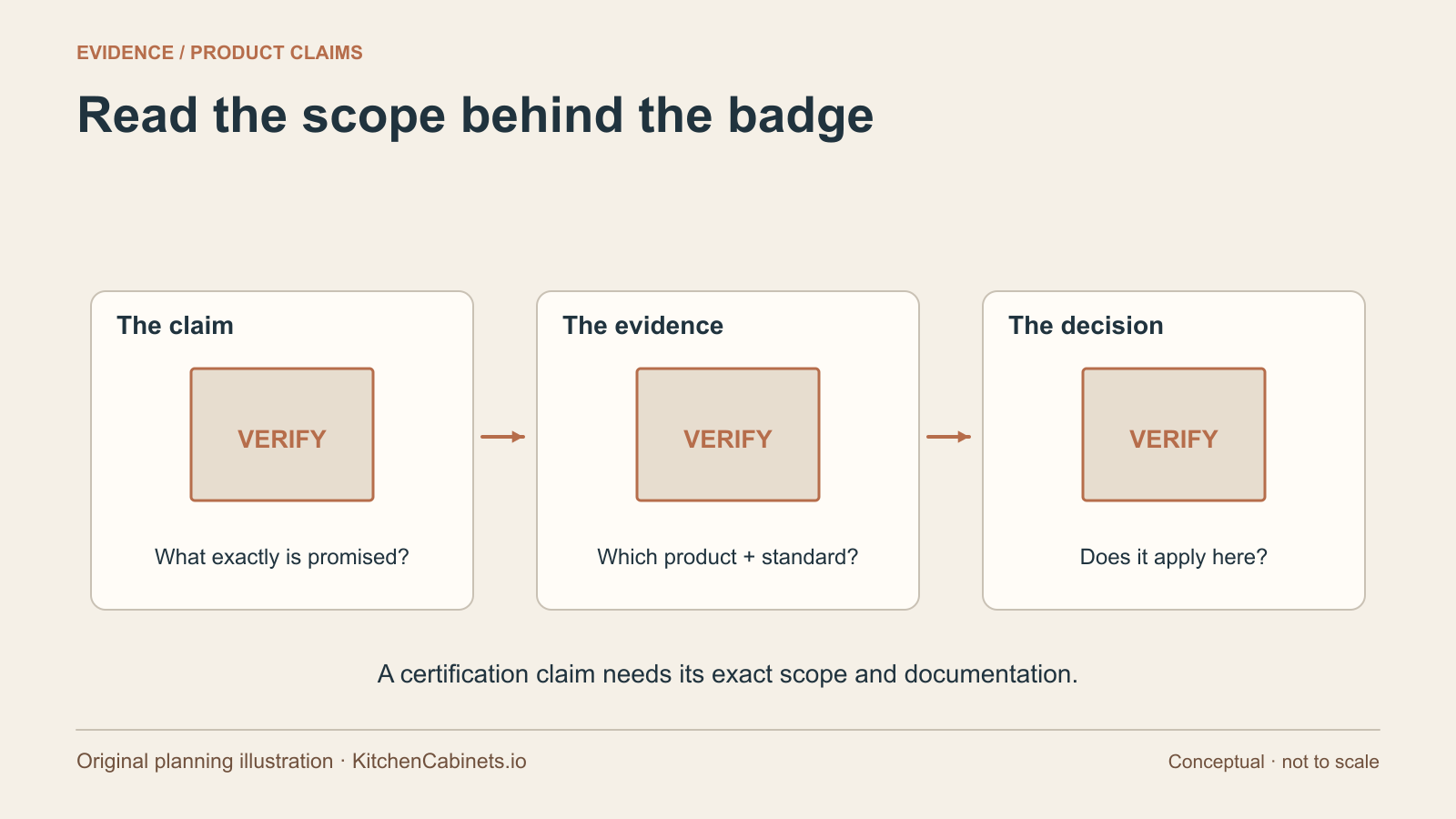
A cabinet quotation can contain several reassuring initials without explaining what any of them cover. One mark may concern how a cabinet assembly performs. Another may describe the sourcing of wood material. A compliance statement may address emissions from regulated composite wood products in a particular market. These questions overlap in a purchasing decision, but the evidence is not interchangeable. A sourcing label does not establish the strength of a drawer, and a performance certification does not describe every ingredient in a finish.
The useful task is to turn each claim into a specific question: which product, which attribute, which document and which scope? This guide provides a way to organize that conversation with a cabinet supplier. It does not certify KitchenCabinets.io, a listed business or any particular cabinet line. It also does not determine whether a product complies with all requirements in your jurisdiction. The goal is a clearer specification, with fewer assumptions hiding behind a logo.
Separate the questions before collecting the paperwork
Start with the outcomes that matter to the project. You may want documented cabinet performance, information about forest sourcing, evidence about composite wood emissions, a particular finish, repairable hardware and an enforceable supplier warranty. Put these in separate rows. A supplier can then answer each row directly, rather than offering one broad statement such as environmentally friendly or premium quality. Those phrases are too open to tell you what was evaluated.
For each row, record the exact manufacturer and cabinet line proposed, the relevant component if the claim is component-specific, the document supplied and its date. Add a column for what remains unresolved. A claim attached to a panel product may be useful evidence about that panel, but it does not automatically extend to the assembled cabinet, adhesive, finish, countertop or installation. Identifying that boundary is part of comparison, not an accusation that the supplier has done something wrong.
Keep appearance and maintenance in the same purchasing conversation without treating them as certification questions. A documented product can still be unsuitable for the household's cleaning habits or preferred look. Conversely, a beautiful sample does not demonstrate performance or sourcing. Ask the practical and documentary questions together, then decide whether the complete package meets the project brief.
Read KCMA as a defined cabinet-performance claim
KCMA describes its A161.1 Quality Certification as a cabinet performance program. Its certification resources also distinguish quality certification from environmental programs. That separation matters when a salesperson uses the organization name without specifying the program. Ask which certification is being claimed, what cabinet line it covers and where the current coverage can be checked. Keep the answer tied to the quotation rather than merely saving a manufacturer homepage with a logo.
A sensible question is: does this documentation cover the actual cabinetry being ordered, including the proposed product line? Do not assume that every offering from a company has identical coverage. If the quote changes to another line, repeat the question. Ask the supplier to explain any limitations in plain language and identify the document that supports the explanation. A useful answer makes the product and program easy to match.
Performance evidence does not eliminate project design decisions. It does not tell you whether an oversized serving platter fits a particular drawer or whether the chosen pantry creates an awkward doorway conflict. Nor should it be treated as a substitute for correct installation. Use documented performance as one input, alongside the drawings, hardware schedule, installation responsibilities and warranty information. The objective is an evidence trail for the actual purchase, not the largest collection of certification badges.
Understand what an FSC label describes
FSC's explanation of its labels distinguishes FSC 100%, FSC MIX and FSC Recycled. These labels communicate different material sourcing claims. In simplified terms, FSC 100% refers to virgin material from FSC-certified forests; MIX can combine eligible certified, recycled and controlled materials; Recycled identifies recycled forest-based material. Read the label explanation and product documentation together rather than collapsing the three into a single claim that every wood element came from the same source.
Ask what product carries the claim and how that claim will be identified in the order documentation. A cabinet proposal may include several materials from different sources. Doors, boxes, decorative panels and trim should not be assumed to share a sourcing claim because one sample or one board does. If sourcing is a project requirement, make the covered items explicit in the specification and ask the supplier how substitutions would be handled.
FSC sourcing information does not itself establish cabinet load performance, formaldehyde compliance, resistance to household chemicals or the supplier's warranty response. Keep those questions separate. Avoid broad claims such as chemical-free or universally sustainable on the strength of a sourcing label. More precise language is more useful: this named product is supplied with this documented sourcing claim, while the finish and performance documents are listed separately.
Treat TSCA Title VI as market-specific compliance information
The United States Environmental Protection Agency's formaldehyde guidance explains TSCA Title VI requirements concerning regulated composite wood products. Its stakeholder questions address compliance, third-party certification, records and labeling in that regulatory context. This is a different subject from whether a cabinet door has a durable finish or whether a drawer runner suits the planned contents. An emissions compliance statement should be read for its product coverage and applicable market.
If a supplier refers to TSCA Title VI, ask which proposed composite wood products the statement covers and what documentation accompanies the finished order. Do not reduce the question to whether the cabinet contains wood: composite products, solid wood elements and finished assemblies can raise different documentation questions. The supplier should identify the relevant materials rather than asking the buyer to infer them from a decorative surface.
This guide does not extend United States requirements to Canada or another jurisdiction. Ask the supplier or a qualified local professional which requirements apply where the product will be supplied and installed. Keep the jurisdiction visible in the evidence table. A familiar foreign acronym can be informative, but it should not silently replace the documentation actually required for the project. Avoid turning an incomplete paperwork review into a declaration that a product is safe, unsafe, legal or illegal.
Build a claim register that survives quotation revisions
A simple claim register can have six fields: item, exact product, claim, evidence, scope and open question. An example item might be the base cabinet box material. The product field records the named panel or cabinet line, not just white interior. The claim field records the supplier's actual statement. The scope field clarifies whether the evidence applies to a panel, a finished cabinet line or another defined item. This structure makes ambiguous statements visible early.
Do the same for doors, exposed ends, drawer components and any material that matters to the brief. There is no need to invent a certification requirement for every screw. Concentrate on the claims the supplier is making and the criteria the buyer has identified as important. A short register that accurately describes six important items is more useful than a long spreadsheet full of blank assumptions.
Give each accepted quotation revision its own document reference. If a panel, finish or cabinet line changes, flag the related evidence for review. Do not carry a tick mark forward merely because the replacement has a similar colour or the same manufacturer name. Ask whether the earlier claim remains valid for the replacement and save the supplier's answer with the change. This is particularly useful when availability causes late substitutions.
Work through a mixed-material kitchen example
Consider a hypothetical kitchen with painted doors, composite-panel cabinet boxes, wood-look exposed ends and metal drawer sides. The buyer wants documented performance and clearer sourcing information. The first quote says certified cabinetry without naming a program. The second names a cabinet line, provides a performance certification reference and separately describes a sourcing option for selected components. The second response is easier to assess, but it still needs checking against the actual order.
The buyer asks the first supplier to identify the certification and covered line. They ask both suppliers which components carry the sourcing claim and whether the finish or panel changes any supporting documentation. They also request the relevant emissions compliance information for the intended market. None of these questions requires assuming that one supplier's product is inferior. They simply turn different presentations into comparable answers.
Now suppose the exposed ends are changed to match an island finish. That alteration might affect only appearance, or it might also change the underlying material and its sourcing documentation. The register makes the follow-up obvious: confirm the new panel and update the associated row. The final decision can then consider the complete package of appearance, construction, evidence, installation and service. A logo alone could not have carried that comparison.
Recognize statements that still need clarification
Some wording sounds specific while leaving the crucial boundary unresolved. Certified materials may identify a component without describing the assembled cabinet. Meets standards may omit the standard, edition or relevant product. Eco finish may describe a marketing position rather than a documented test. Ask for the named document and the product it covers. If the answer is not available, record the status as unconfirmed rather than improving the wording yourself.
A laboratory report also needs context. Ask whether the sample described matches the proposed product and what the report actually evaluated. Do not infer broad household outcomes from an unfamiliar test name. Where a technical interpretation matters, have the supplier explain it or seek an appropriately qualified independent reviewer. The buyer's responsibility is to recognize the unresolved question, not to become a testing laboratory overnight.
Avoid copying certification language into a public project description before its scope has been established. A dealer, designer or homeowner can accurately say that documentation was requested and reviewed. Calling an entire project certified may imply something much wider. If sharing the finished kitchen, use precise product-level wording supported by the supplied documents and check any rules governing the use of marks or logos.
Keep installation, maintenance and warranty evidence separate
Even a well-documented product needs an installation and care plan. Ask who supplies the installation instructions, who is responsible for attachment and appliance coordination, and what information the owner receives at handover. These details answer different questions from certification, but they strongly affect the practical ownership experience. A cabinet that was selected thoughtfully can still be difficult to service if product codes and installation records disappear.
Read the actual warranty alongside the quotation. Identify who receives a claim, what information is needed and how replacement components are identified. Do not assume a certification guarantees a particular repair, labour payment or response time. Those expectations must come from the relevant warranty and supplier commitments. Keep promises about service in writing instead of treating a quality mark as a substitute for them.
Maintenance instructions should identify the specific surfaces installed. If doors, laminate panels and metal drawer sides require different care, a single generic cleaning paragraph is inadequate. Store the care guidance with the product schedule and warranty contacts. This creates a practical handover file: the owner can identify the product, understand its documented claims and follow the appropriate care instructions without reconstructing the purchasing conversation.
Make the final decision with known gaps visible
Before ordering, review the evidence against the buyer's original priorities. Mark each priority as supported, unresolved or not applicable, with a short explanation. An unresolved item is a decision point: obtain more information, revise the specification or consciously choose another option. Do not silently translate missing documentation into either a passing result or proof of failure. Clarity is valuable even when the answer remains incomplete.
Save the accepted product schedule, claim register and supporting links or documents together. Check that the final invoice and delivery information correspond to the accepted products. If a substitution arrives, pause the affected decision and ask for an updated explanation before treating earlier evidence as applicable. This habit protects the integrity of the specification without requiring an adversarial relationship with the installer or dealer.
The most useful certification conversation ends with specific statements you can explain. You know what was evaluated, which proposed item it concerns, where the evidence is and which questions remain separate. That gives performance, sourcing and emissions information their proper place beside design and service. It also makes a cabinet comparison more honest: the decision rests on the actual kitchen being purchased rather than the reassuring appearance of initials on a brochure.
Give the evidence a usable filename
A folder of unnamed downloads is easy to lose track of when the order changes. Name each saved document so the product, document type and relevant revision are recognizable, and connect it to the corresponding row in the claim register. Keep the original document intact rather than extracting a reassuring paragraph without its qualifications. If a supplier provides a link, note when it was reviewed and the product it supported. This does not extend the document's scope; it makes the existing evidence easier to find and reassess when a substitution, warranty question or later project requires it.
Sources and editorial notes
This is original explanatory reporting and planning analysis. Manufacturer documents support the specific product facts attributed in the guide; they do not imply affiliation. Sources were checked for this launch. The illustration was created for this article; it is not a photograph of a completed project.
Corrections or a documented technical update? Email the editorial desk.