Materials · Homeowners comparing cabinet construction specifications
Cabinet Box Materials: Ask About the Whole Assembly, Not Just Plywood
Compare plywood, MDF and other cabinet components through their complete assembly, grade, edges and intended conditions.
Start with the practical decision
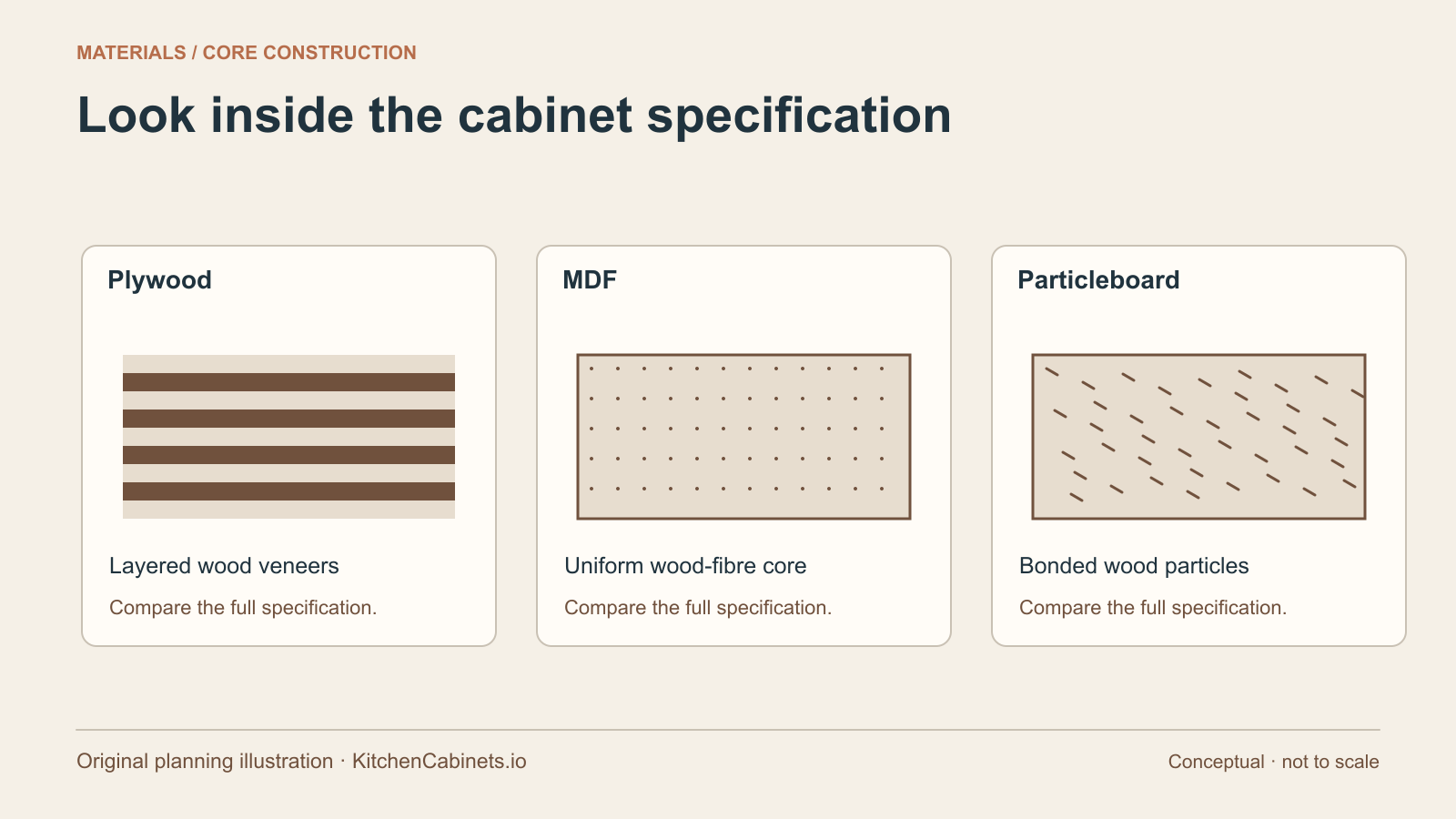
Plywood, MDF and particleboard describe families of panel materials, not complete promises about a kitchen cabinet. A quotation that says “all plywood” can still leave the back, drawer bottoms, shelves, edge treatment and fastening details unclear. Another cabinet might use a different panel intelligently but provide no useful explanation of how it is protected around a sink. The practical comparison starts with the complete assembly: which component uses which material, how the parts are joined, what loads they carry, and what the manufacturer says about moisture and care.
This is a guide to asking better specification questions, not a ranking that declares one panel best for every kitchen. Product grades, thicknesses, coatings, hardware and installation details differ. A material suitable for a painted door may not be the material a designer chooses for a long loaded shelf. The same word on two quotations may refer to different products. Request a component schedule and a sample of the actual construction where possible. If a supplier substitutes a material, ask for the revised specification rather than accepting a verbal statement that the replacement is equivalent.
Separate the cabinet's components before comparing materials
Draw a simple cabinet and label its sides, bottom, top or stretchers, back, shelves, doors and drawers. Then ask the supplier to identify the material and thickness for each part. Include exposed ends and any finished panels added outside the basic box. This turns a broad sales description into information that can be checked. A plywood box with a thin back is not described adequately by the same two-word label as another assembly with a different back and hanging arrangement. Neither is necessarily unsuitable; they need a fair comparison of the actual construction and intended use.
Keep doors and cabinet boxes in separate columns. A painted MDF door on a plywood cabinet is not a contradiction, and a solid-wood door does not mean that the cabinet sides are solid timber. Ask how the door's finish, edge profile and hinges suit the chosen substrate. Similarly, identify drawer-box construction and drawer-bottom material independently from the door fronts. This is especially important when comparing a showroom display with a quotation: the attractive part at eye level may tell you little about the panel, back and shelf configuration included in the specific cabinet line.
Treat plywood as a specification, not a guarantee
Plywood consists of bonded wood veneers, but the name alone does not identify the grade, veneer arrangement, adhesive performance, exposed-face quality or panel thickness. Ask which product the manufacturer uses and which written performance information applies to it. If a cabinet has a visible plywood edge, inspect the finish as well as the layers. Voids, rough edges and badly protected penetrations are different questions from whether the material belongs to the plywood category. Avoid assuming every panel with visible plies has the same resistance to damage, the same fastening performance or the same appearance after finishing.
A useful question is what the plywood is doing in this cabinet. Does it provide the side structure, support adjustable shelves, form the back, or simply appear in the drawer box? Ask how shelves are supported and whether any loading limits are stated for the actual cabinet width and shelf configuration. That makes the discussion more concrete than an argument about a material in the abstract. The Kitchen Cabinet Manufacturers Association's construction standard evaluates the cabinet through construction and performance requirements, including sufficient rigidity; the standard does not say that using one panel name alone establishes cabinet quality.
Understand why MDF appears in cabinet specifications
Medium-density fibreboard is commonly specified for parts that need a uniform machined or coated surface. The relevant question is which MDF product is being used, where it sits in the assembly, and what conditions the manufacturer permits. MEDITE SMARTPLY distinguishes between general-purpose and moisture-resistant products in its technical material. That distinction matters more than an unqualified statement that a cabinet contains MDF. Ask the cabinet supplier to identify the actual grade and finishing system, particularly for edges, routed profiles and holes that may be less protected than the flat face.
Do not turn a preference for one appearance into a claim about all service conditions. A smooth painted door and a cabinet bottom beside a plumbing leak have different jobs. Request the manufacturer's use and care instructions for the specific substrate and finish. Ask whether any damaged component can be replaced separately and what information must be retained to match a replacement later. The ability to order a door or panel from an identified line may be more useful in practice than a broad material promise with no product designation, finish code or after-sales process behind it.
Moisture-resistant does not mean waterproof
MEDITE's own FAQ states that its MEDITE MR product is not waterproof. It is intended for appropriate humid interior conditions, with the manufacturer's specified preparation and finishing, rather than prolonged direct wetting. Use that as a reminder to read the precise product documentation; do not transfer its specification automatically to every green-coloured board or every MDF product sold by a different manufacturer. A moisture-resistant grade is one layer of a cabinet's protection. It does not remove the need to prevent leaks, protect edges, maintain finishes and respond promptly when water enters the assembly.
Around a sink, ask how the bottom, sides and service penetrations are finished. Look for an answer about the assembly rather than a reassurance that the panel is “marine,” “premium” or “water resistant.” A tray or leak sensor can help reveal a problem, but neither proves the cabinet beneath it can withstand a continuing leak. If a supplier promises a water-damage warranty, request the written terms and exclusions. The important distinction is between a material's tested classification and the conditions under which the finished cabinet is actually covered and expected to perform.
Give particleboard the same careful examination
Particleboard should also be identified by product, thickness, finish and application rather than dismissed or praised as a single uniform material. A cabinet using particleboard still needs adequate construction, edge protection and suitable hardware attachment. Ask how fasteners are selected for the panel and whether the cabinet line has an established installation method. A material label does not explain whether a shelf is appropriately supported or a hanging rail is correctly fixed. Look at those details directly, especially in cabinets that will hold heavy items or be installed beside plumbing and appliances.
Compare complete specifications instead of trying to settle the question with a fingernail test or a sample offcut. An offcut can show a core and surface, but it cannot demonstrate the performance of the assembled cabinet under repeated use. If the supplier refers to certification or testing, ask which cabinet line and configuration the statement covers. Do not borrow a certification mark from another manufacturer's website and attach it to a proposed product. Evidence should belong to the actual item being quoted, and the supplier should be able to explain the claim without relying on a generic brochure image.
Look closely at edges, joints and backs
Edges, joints and penetrations deserve attention because they are easy to miss during a showroom visit. Ask how exposed edges are sealed or banded, how joints are formed and how the back connects to the rest of the box. A flat finished face is only part of the cabinet. Look inside a sample, inspect a removable shelf and ask to see the rear or a construction drawing. KCMA's standard addresses rigidity and workmanship in the cabinet assembly; use that performance-minded approach when asking questions instead of assuming a thick side panel compensates for every other detail.
Installation must be part of the discussion. Ask how the manufacturer's cabinet is fixed to the wall, how adjoining cabinets are connected, and what the installer does when walls are not straight or floors are not level. This is not a request for a homeowner to improvise fastener specifications. It is a request for the supplier to identify the correct installation instructions and responsibility. A strong panel can still be part of an unsatisfactory installation if the load path, wall fixing or levelling is not handled according to the product and site conditions.
Compare loaded shelves and drawers as assemblies
List what each cabinet will actually store. Plates, small appliances and cookware can create very different demands from a lightly filled display cabinet. For adjustable shelves, ask about the stated loading and support arrangement for the relevant width. For drawers, confirm the runner system and its load class, then ask whether the rating includes the drawer assembly. Do not combine a hardware manufacturer's headline capacity with an unrelated drawer box and assume the complete cabinet now has that capacity. The box, bottom, fittings and installation all need to work together.
A practical comparison might describe two proposed wide pantry cabinets that look similar from the front. Supplier A identifies the shelves and supports but gives no loading information. Supplier B provides a written limit for its actual shelf configuration and explains when another support is needed. That does not prove B is automatically the better product overall, but it gives you a question that A still needs to answer. Keep the comparison tied to the proposed width, contents and support system. It is more useful than treating one sample panel as a test of the whole kitchen.
Read care instructions before approving a finish
Maintenance requirements can expose a mismatch between a material and the way a household uses the kitchen. KraftMaid's care guidance, for example, addresses cleaning and moisture management for its own cabinet products. Follow the instructions belonging to the product you buy, not a universal recipe from a social-media video. Ask about cleaning products, standing moisture, steam exposure and touch-up procedures. A finish may look excellent in a display but require care that the owner did not expect. Knowing that before ordering allows a more informed choice of finish, door detail and protection around wet areas.
Think about repair as well as initial appearance. Ask what a damaged edge, swollen panel, chipped coating or scratched visible end would mean for the proposed product. Can the affected component be replaced, touched up or refinished, and who provides the matching part? Do not assume every panel can be sanded like solid timber, or that every painted finish can be matched invisibly on site. An honest explanation of repair limits is useful product information. Record finish identifiers and keep a copy of the original order so a future repair is not based solely on a photograph.
Make a fair side-by-side quotation schedule
Create a comparison sheet with rows for cabinet sides, bottom, back, shelves, doors, drawers, hardware, finish and installation. Add columns for exact material, thickness, product line, written performance information and exclusions. Put unanswered questions in the sheet rather than filling them with assumptions. If one proposal includes finished end panels and another does not, align the scope before comparing the total. If a supplier offers an upgrade, ask which components change and which remain the same. A price for an “all-plywood upgrade” is hard to assess without that component-level explanation.
Use the same process for environmental and emissions claims. Ask which standard, certification or document applies to the actual product and where it can be checked. A low-emission claim about a raw panel is not automatically a complete statement about every material and coating in a finished kitchen. Avoid making a health-performance claim from an unfamiliar acronym. The supplier should identify its documentation and explain the scope. Your decision can then weigh appearance, service conditions, performance evidence and repairability without asking a single material word to stand in for all of those considerations.
Choose a cabinet that fits the room and the responsibilities
Before the order is released, resolve the important material questions in writing and connect them to the actual layout. Identify which cabinets sit near water, which shelves carry demanding loads and which visible panels need a particular finish. Confirm the installer has the correct instructions and that the owner has the correct care information. Use KitchenCabinets.io's retained city and planning pages to organise the conversation, not as an endorsement of a supplier's specification. The final decision should be traceable to the product being supplied and the way it is intended to be used.
The strongest comparison is rarely a slogan. It is a record showing that the cabinet line, component materials, construction, finish, hardware and installation have been considered together. A plywood specification may be important to your project, but it should be one informed requirement among several. A moisture-resistant board may be appropriate, but it should never be treated as permission to ignore a leak. Ask for the complete assembly, understand its limits and retain the documents. Those habits will help you compare proposals more reliably than choosing by the most reassuring material name on the cover page.
Sources and editorial notes
This is original explanatory reporting and planning analysis. Manufacturer documents support the specific product facts attributed in the guide; they do not imply affiliation. Sources were checked for this launch. The illustration was created for this article; it is not a photograph of a completed project.
- KCMA: ANSI/KCMA A161.1–2022 Performance and Construction Standard
- MEDITE SMARTPLY: Frequently asked questions
- KraftMaid: Cabinet care and cleaning
Corrections or a documented technical update? Email the editorial desk.